

Saturday, April 25, 2026
  • Home
  • About Us
  • Refund Policy
  • Privacy Policy
  • Terms and Conditions
  • Advertise With Us
  • Contact Us
  • Login
  • Register
SUBSCRIBE
Welcome to Saviours Voice of Khaki
Advertisement
ADVERTISEMENT
  • Foreign Policy
  • Internal Security
  • Policing
  • Border Management
  • Corrections
  • Disaster Management
  • Interviews
  • General
No Result
View All Result
  • Foreign Policy
  • Internal Security
  • Policing
  • Border Management
  • Corrections
  • Disaster Management
  • Interviews
  • General
No Result
View All Result
Welcome to Saviours Voice of Khaki
No Result
View All Result
Home Economy

The Indus Waters Treaty: A Gentleman’s Agreement with a Terrorist State

KBS SidhubyKBS Sidhu
April 25, 2026
in Economy, Foreign Policy, General, Internal Security
Reading Time: 16 mins read
0
0
The Indus Waters Treaty: A Gentleman’s Agreement with a Terrorist State
Share on FacebookShare on TwitterShare on LinkedInShare on WhatsApp
From Abeyance to Strategic Leverage — Water, Sovereignty, and National Security in a Changed World

A Compact Born of Generosity, Sustained by Self-Denial

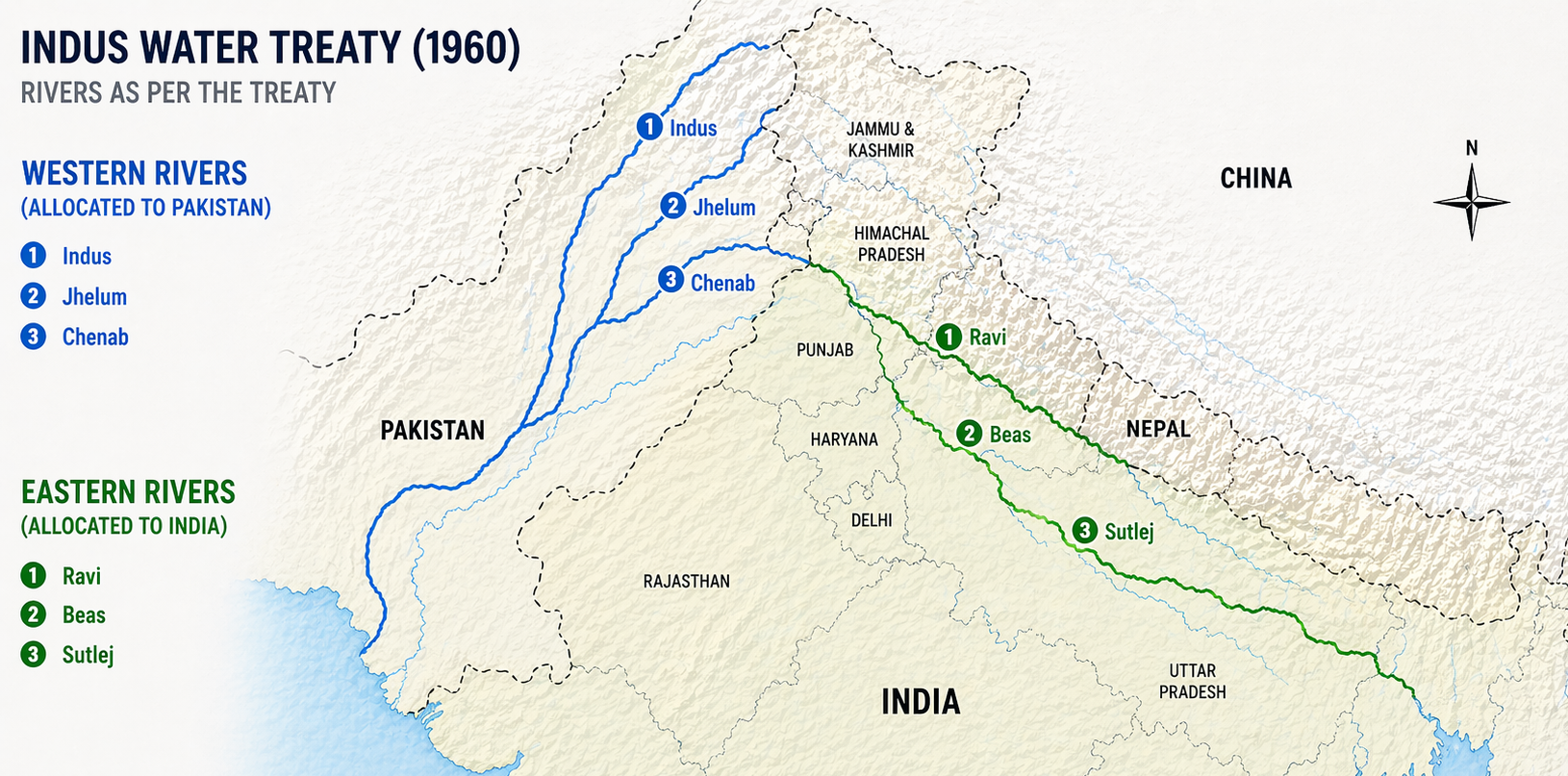
The Indus Waters Treaty of 1960 was, even by the standards of its time, an act of remarkable — and ultimately imprudent — generosity. Negotiated under the auspices of the World Bank over nine tortuous years and signed by Prime Minister Jawaharlal Nehru and President Ayub Khan on 19 September 1960, the treaty allocated the three eastern rivers — Ravi, Beas, and Sutlej — to India’s exclusive use, and consigned the three far larger western rivers — Indus, Jhelum, and Chenab — overwhelmingly to Pakistan. The arithmetic was staggering in its imbalance: Pakistan received approximately 135 million acre-feet (MAF) per annum; India accepted barely 33 MAF, roughly twenty per cent of the total Indus basin flow. India, the upper riparian, the country through which these rivers descend from the Himalayas and Karakoram, willingly constrained itself so that a lower riparian — already, at partition, adversarial — could irrigate its fields.

The assumptions that underwrote this bargain were, in hindsight, profoundly optimistic. The treaty assumed that Pakistan was genuinely committed to the norms of civilised inter-state relations. It is assumed that the elaborate dispute-resolution machinery — the Permanent Indus Commission, the Neutral Expert, the Court of Arbitration — would operate in good faith. It is assumed that the developmental needs of India’s border states, the demographic pressures on Punjab’s agriculture, the irreversible depletion of groundwater, and the shifting hydrology of a warming Himalayan landscape would remain frozen in the geopolitical amber of 1960. Not one of these assumptions has survived intact.
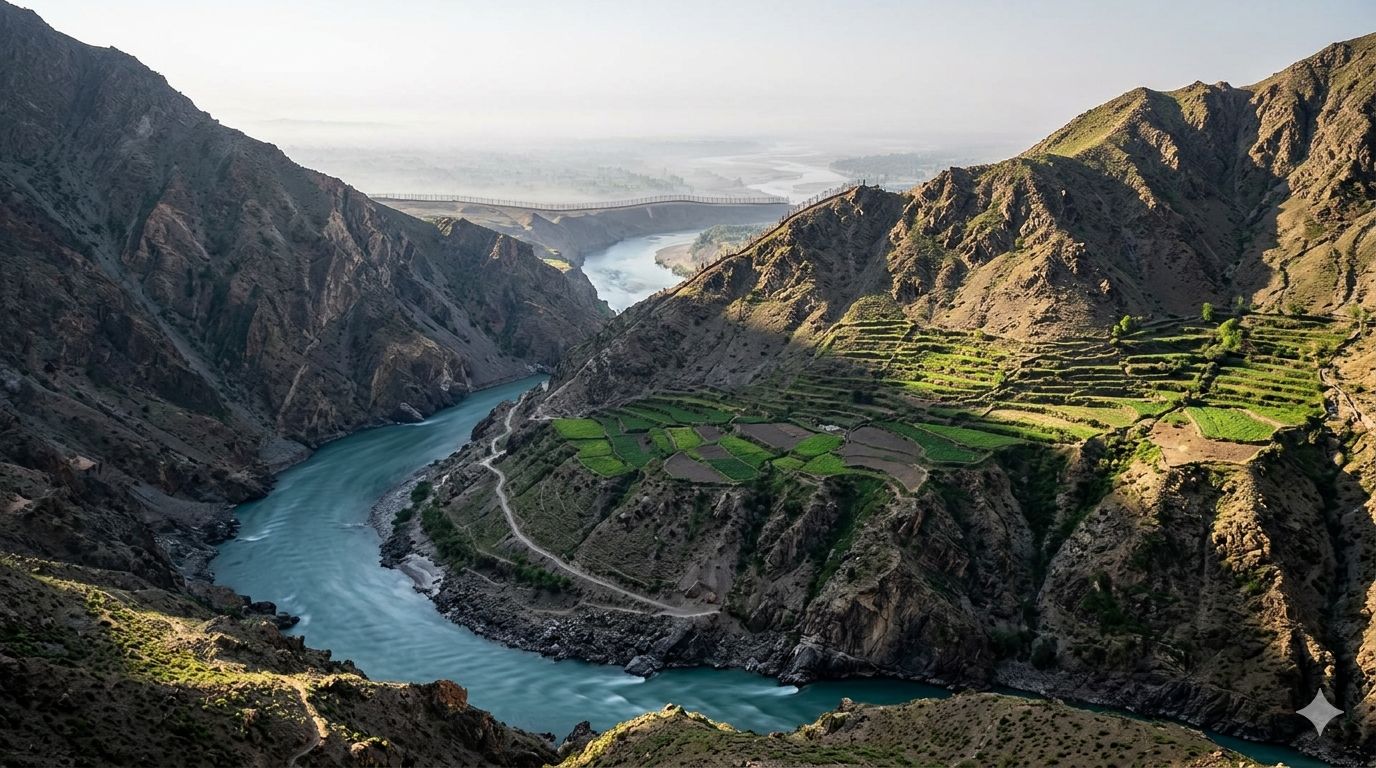
Sunrise on the Jhelum as viewed from the Line of Control(LoC). Himalayan waters are split more by treaty and geography.

Over the past 65 years, India has utilised even its modest eastern river entitlement with chronic inefficiency. The Ranjit Sagar (Thein) Dam, conceived in the early 1960s, was not commissioned until 2000. Shahpur Kandi Dam, a critical downstream balancing reservoir on the Ravi, spent twenty-eight years mired in inter-state cost disputes before civil works were finally completed in 2024. The Ujh Multipurpose Project on a Ravi tributary secured central approval only in 2022 and remains incomplete. Each year of delay has allowed roughly 0.6 MAF of India’s own Ravi entitlement to flow unhindered across the border into Pakistan, while farmers in the Malwa region in the Indian Punjab drill ever deeper for groundwater and the water table sinks by nearly half a metre annually.

On the western rivers — the Indus, Jhelum, and Chenab — India’s record is even more dispiriting. The treaty permits 3.6 MAF of live storage on these rivers; India has built a fraction of that, largely the small pondage at Baglihar. Technical assessments place India’s hydropower potential on the western rivers at 18.6 gigawatts; installed capacity has struggled to reach 3.2 GW. Pakistan, meanwhile, weaponised the treaty’s dispute architecture with relentless efficiency — contesting the design of Baglihar, Kishanganga, and Ratle through every available forum, converting what was intended as a safety valve into a mechanism of deliberate harassment and developmental paralysis. When India formally invoked Article XII(3) in August 2024, seeking renegotiation to reflect sixty-five years of changed circumstances — demographic growth, environmental degradation, energy needs, climate change — Pakistan refused even to engage.

The door was already closing. Pahalgam forced it shut.

Pahalgam and the Right of Abeyance — The Legal Foundation
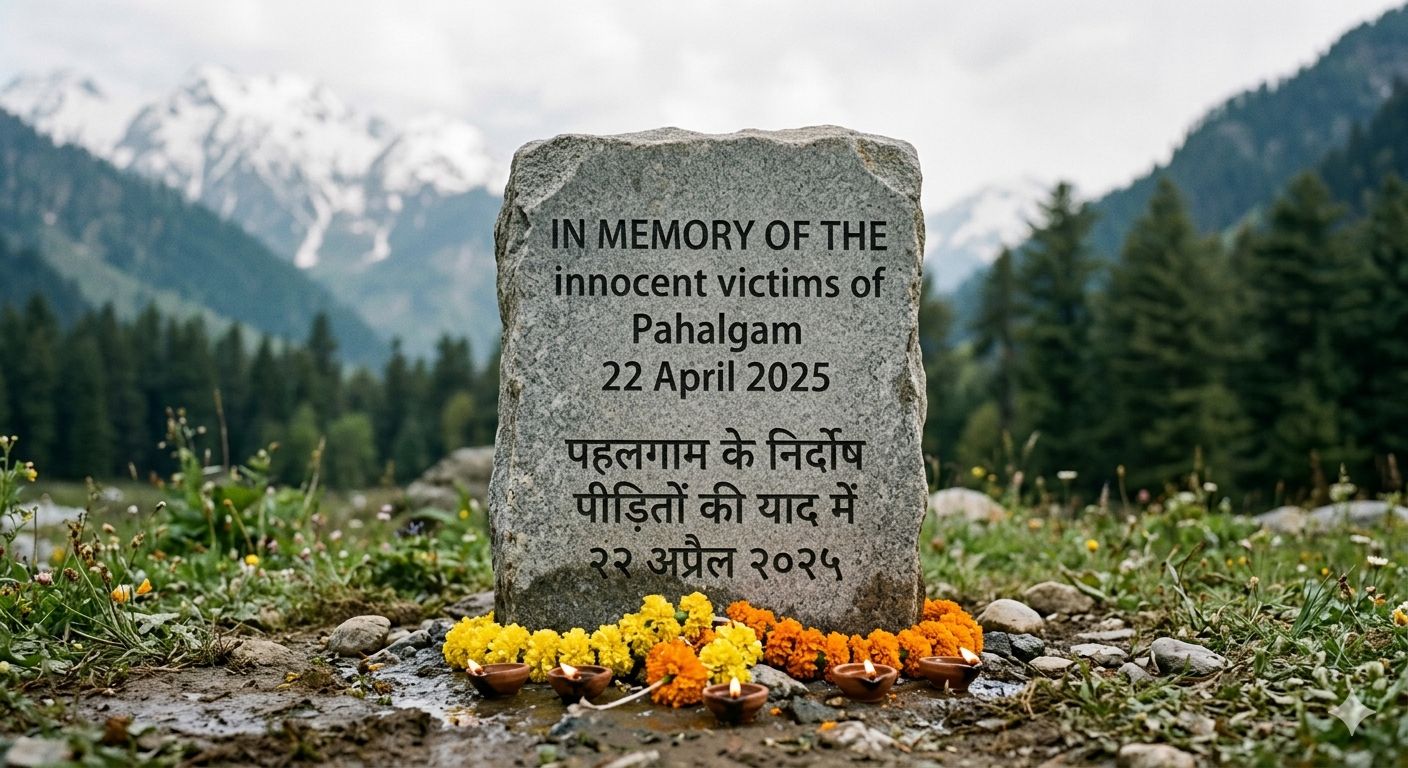
The massacre at Pahalgam on 22 April 2025, in which twenty-six civilians were murdered in cold blood by terrorists whose handlers have been traced by Indian intelligence to Pakistan-based networks, was not simply an atrocity. It was the breach of the last foundational premise on which India had sustained the treaty through three wars, the Kargil incursion, the Mumbai attacks of 2008, Pulwama, and Uri. India placed the Indus Waters Treaty in abeyance the very next day. The decision was immediate, unambiguous, and legally defensible.
Senior Advocate Mohan Katarki — India’s foremost authority on inter-state river water law, formerly counsel for Punjab in water disputes before the Supreme Court — has correctly established that the treaty contains no express prohibition on suspension. Under the doctrine of rebus sic stantibus in general international law, a state party may suspend or withdraw from a treaty when there has been a fundamental change of circumstances that could not have been foreseen at the time of conclusion, and that change radically alters the extent of obligations still to be performed. Pakistan’s six-decade record of sponsoring cross-border terrorism — culminating in a massacre on Indian soil — constitutes precisely such a change. India is under no enforceable compulsion, in law or in conscience, to maintain a water compact that subsidises the agricultural economy of a state that exports terror as an instrument of foreign policy.
Pahalgam, April 2025. A granite memorial stone honours the victims of Pakistan’s murderous assault. The natural beauty of the Lidder Valley is stunned into mourning.

It is also worth noting the technical case for review, independent of the security dimension. The treaty’s annexures, drafted for a pre-computer age, impose storage caps and structural design constraints that render true multi-purpose reservoirs on the western rivers almost impossible to build. They embed a procedural architecture that Pakistan has systematically exploited — filing objections, triggering international arbitration, seeking stays — to delay, redesign, or abandon Indian projects. In August 2025, the Permanent Court of Arbitration at The Hague issued, ex parte and without India’s participation, an Award on Issues of General Interpretation essentially directing India to ‘let flow’ the western rivers for Pakistan’s unrestricted benefit. India has correctly and contemptuously refused to recognise the tribunal’s jurisdiction. No external forum can compel India to act against its own national security and sovereign riparian rights. The era of deference to bodies that Pakistan alone has chosen to invoke — while sponsoring violence — is over.

The World Has Changed — Sovereignty Trumps Parchment

India’s decision to hold the IWT in abeyance must be read against the dramatically altered landscape of international conduct in the current era. Across the globe, the fiction that international treaties, conventions, and norms automatically constrain sovereign behaviour in matters of existential national interest has been comprehensively shredded. The lesson is not comfortable for liberal internationalists, but it is unambiguous: nations, when sufficiently pressed, subordinate treaty text to sovereign survival. The niceties of international law are observed when observing them costs nothing; they are discarded when the price becomes unacceptable.

Iran is the most instructive contemporary parallel. Facing sustained military assault by the United States, Israel, and their regional allies — including strikes on its nuclear infrastructure, assassination of its scientific and military leadership, and an extended campaign of economic strangulation — Iran has not retreated behind the Vienna Convention or invoked international arbitration. It has acted unilaterally, assertively, and in calculated defiance of norms it regards as weaponised against its interests.

The most audacious expression of this sovereign defiance has been Iran’s seizure of the Strait of Hormuz — the narrow, twenty-one-mile choke-point through which, in normal times, some twenty per cent of the world’s seaborne oil and a fifth of its liquefied natural gas passes every day. When the United States and Israel launched their air war against Iran on 28 February 2026, the Islamic Revolutionary Guard Corps (IRGC) effectively closed the strait, reducing daily tanker transits from approximately 110 vessels to fewer than ten. What followed was without precedent in the modern law of the sea: Iran converted one of the world’s most critical maritime passages into a toll booth. The IRGC began charging vessels seeking safe passage at a rate of one dollar per barrel of cargo — translating, for a very large crude carrier loaded with two million barrels, to a transit fee of up to two million dollars per vessel. Payments have been demanded and accepted in Chinese yuan and cryptocurrency, entirely outside the dollar-denominated international financial system. The system has been aptly christened the ‘Tehran toll booth’ by the global shipping industry.

Iran has gone further still. Its parliament has passed legislation formalising the toll structure, and Tehran has formally demanded, as one of its five conditions for ending the war, international recognition of Iran’s sovereignty over the Strait of Hormuz — a waterway that the United Nations Convention on the Law of the Sea designates as subject to the right of transit passage for all nations. President Trump has blustered on social media that Iran ‘better not’ impose such fees. Iran has imposed them anyway. The international legal order, in short, has been unable to prevent a nation under existential military assault from asserting sovereign control over a natural chokepoint and extracting a price for its use. The norms have bent. The geography has not.

The lesson for India is direct and operational. India is the Strait of Hormuz of South Asian waters. The Indus, Jhelum, and Chenab originate in the Indian territory. They descend through Jammu & Kashmir and Ladakh under India’s geographic command before crossing into Pakistan. Pakistan’s agricultural economy — its wheat belt, its cotton fields, its two hundred million acres of irrigated land — is as dependent on these flows as the Gulf states are on Hormuz transit. When India has built the inter-basin transfer infrastructure that converts the abeyance into hydrological fact, it will hold, in the water domain, precisely the kind of structural leverage that Iran is exercising in the maritime domain — with one critical difference. India’s leverage will be entirely lawful, domestically legislated, and grounded in the sovereign right of an upper riparian to utilise its own river waters for its own people. No court of arbitration, no Permanent Court of Arbitration award issued ex parte at The Hague, and no United Nations resolution can alter the physics of a river. Iran’s conduct is not a moral benchmark; it is an empirical demonstration of what sovereign geography, firmly commanded, can achieve. India’s suspension of the IWT is measured, legally grounded, and proportionate by comparison — yet the underlying principle is identical: a nation’s sovereign interests, rooted in its physical geography and its security imperatives, override the obligations of a compact entered into under utterly different conditions with a counterpart that has systematically violated the compact’s foundational premise of good faith.

The United States itself has, over the past decade, withdrawn from or repudiated international agreements — the Paris Climate Accord, the Trans-Pacific Partnership, the Iran nuclear deal, the Intermediate-Range Nuclear Forces Treaty — on the grounds of a changed national interest, without suffering any enforceable international consequences. Russia has violated the Budapest Memorandum guaranteeing Ukraine’s territorial integrity with impunity. China has ignored the 2016 South China Sea Arbitral Award with equal impunity. The international legal order is not, in practice, a system of enforceable constraint on great powers; it is a vocabulary that states deploy selectively, invoking it against adversaries and ignoring it when it inconveniences themselves. India, for too long, has played by rules no one else followed.

The fragile ceasefire that ended the confrontation between India and Pakistan following Pahalgam was, in a supreme irony, brokered in significant measure by Pakistan itself — a country that simultaneously harbours, finances, trains, and deploys terror networks and presents itself to an international audience as a responsible peace-broker. This paradox must not escape New Delhi. A state that plays peacemaker on one track while sustaining the infrastructure of mass murder on another has forfeited the right to the protections of ‘gentlemanly’ international agreements. Pakistan cannot hide behind the IWT when it has walked away from every norm of civilised inter-state conduct that the treaty was meant to reflect.

The altered geostrategic environment offers India a specific and time-limited diplomatic opening. The United States, increasingly frustrated with Pakistan’s double-dealing — its role as both counterterrorism partner and terror sanctuary — and acutely aware of the regional instability that emanates from Rawalpindi’s military-intelligence complex, is in a position to apply meaningful pressure on Pakistan not to convert a bilateral water dispute into an international sympathy campaign. India must use this window with urgency and precision. Washington should be left in no doubt that India will not accept any international mediation or arbitral award on the IWT while Pakistan continues to sponsor violence on Indian soil. The price of American silence in international forums on this question should be clearly articulated and, where necessary, extracted.

The National Security Dimension — Water as a Strategic Asset

The Indus Waters Treaty has never been merely a water compact. It has always been, simultaneously, a national security issue — one that India has been extraordinarily slow to recognise and slower still to act upon. A Punjab chronically short of surface water, forced to mine its aquifer at a rate far exceeding recharge, growing increasingly desperate, increasingly indebted, and increasingly vulnerable, is not merely an agricultural crisis. It is a strategic liability of the first order. A depleted Punjab on India’s most sensitive border with Pakistan is an invitation to instability — social, political, and ultimately security-related. The two questions — how much water flows through India’s canals and whether the border is secure — are not separate. They are the same question.

Punjab today draws barely twenty-seven per cent of its irrigation from surface water. The rest comes from groundwater that is being exhausted at a rate that should alarm every security planner in South Block. The state’s extraction rate of 34 billion cubic metres per year runs against a recharge of 22 billion cubic metres — a structural deficit of 12 BCM annually. The water table declines by nearly half a metre every year. In some districts of Malwa, the decline is even steeper. Within a generation, without radical intervention, Punjab’s agriculture — the foundation of India’s food security — faces a crisis that no amount of minimum support price policy or farm loan waiver can address. The groundwater simply will not be there.
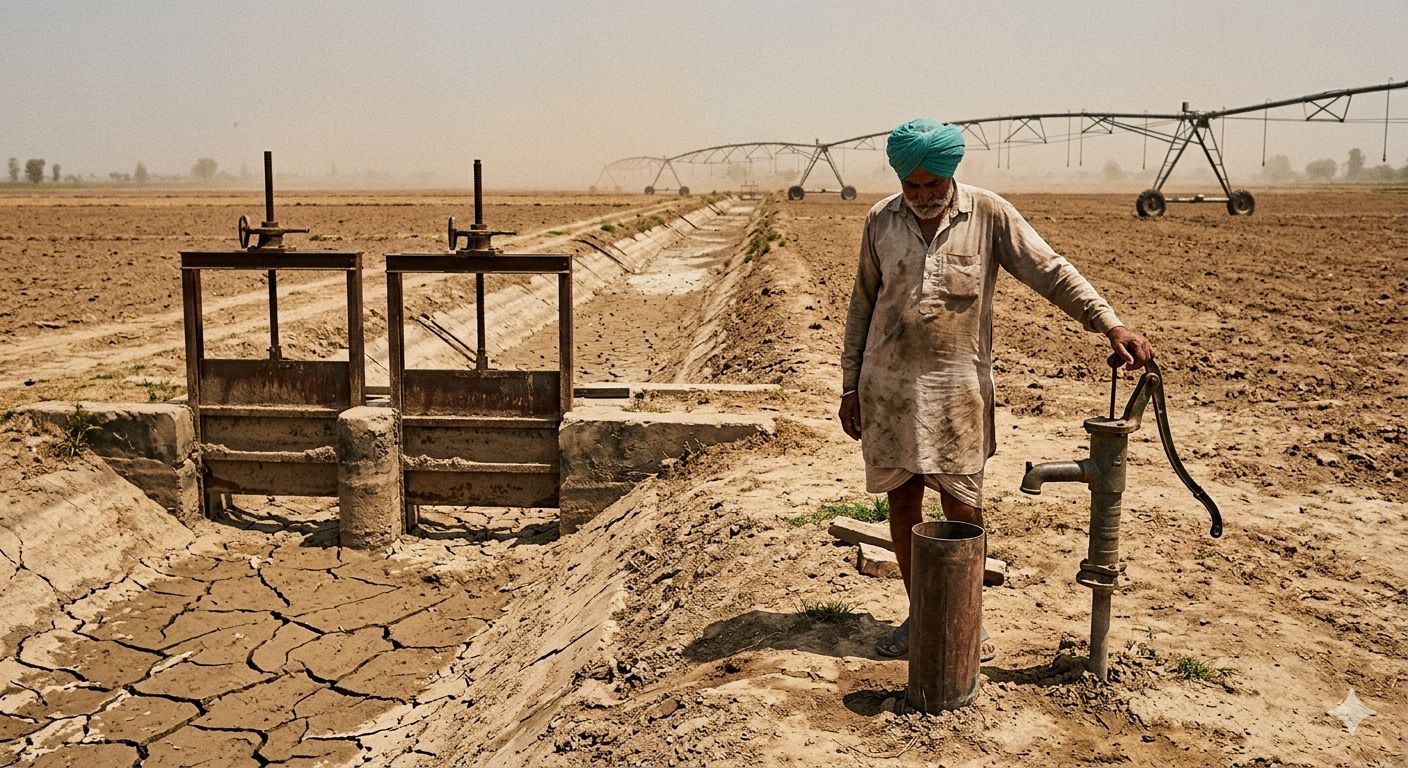
Punjab Water Crisis: A dry canal and an empty well in the Malwa region signal the urgency of utilising our share of river water.

The western rivers of the Indus basin are the answer to this crisis. They are, quite literally, the solution that flows past Punjab’s border every year while India watches. The Chenab, the Jhelum, the Indus — rivers that rise in India’s territory, descend through Jammu & Kashmir and Ladakh, and carry water that India has, under the iniquitous terms of the 1960 treaty, been legally constrained from using for consumptive purposes — can be made to serve Punjab’s farmers, Punjab’s aquifers, and India’s border security. Their waters are a sovereign national resource. They must be treated as such — not as a matter of agricultural policy but as a matter of national security, addressed with the urgency, funding, and institutional focus that the category demands.

The national security case extends beyond Punjab. Jammu & Kashmir, now a Union Territory directly administered by the Centre, stands to gain enormously from the infrastructure that the treaty’s abeyance makes possible. Hydropower from the Chenab and Jhelum cascades will reduce J&K’s dependence on imported energy, power its industries, and reduce the economic marginalisation that has for decades fed separatist sentiment. Irrigation infrastructure in the Kathua-Samba corridor will integrate the border belt economically into the Union — a canal is a more durable instrument of national integration than any other measure. The Ujh Multipurpose Project, the Bursar and Sawalkot dams, the Marhu Tunnel connecting the Chenab to the Ravi-Beas system — these are not merely engineering projects. They are instruments of statecraft.

There is also the dimension of military water security. The Indus system supplies drinking water to the Indian Army’s deployments across Ladakh, the Siachen Glacier, and the Line of Control. As climate change shrinks glaciers and alters seasonal flow patterns, the Army’s water supply chains become increasingly precarious. Investments in storage and distribution infrastructure along the upper Indus and its tributaries serve both military and civilian purposes. When the Chief of Defence Staff and the National Security Advisor speak of infrastructure as the foundation of border defence, they are speaking, among other things, of water infrastructure. The strategic planners at South Block and the Integrated Defence Staff must be brought into the IWT conversation — not as observers but as principal stakeholders.

The Engineering Strategy — Connectivity, Not Headlines

There is a temptation — understandable given the political climate, but strategically dangerous — to play to the gallery on the water question. To announce water cutoffs. To hint darkly at diversion. To make Pakistan flinch with every news cycle. India must firmly resist this temptation. It is counterproductive for two reasons. First, the existing run-of-river projects on the western rivers — Baglihar on the Chenab, Kishanganga on the Jhelum — were designed under treaty constraints for power generation, not consumptive storage. Their pondage is minimal. Closing their gates produces headlines, not dams, and costs India the electricity it generates. Second, and more importantly, threatening what one cannot yet deliver is a confession of weakness, not strength. India’s leverage over Pakistan’s water supply will be real, permanent, and credible only when the infrastructure to exercise it is built.

The topography of Jammu & Kashmir and Ladakh imposes real engineering constraints. The gorge country is seismically active, precipitation is extreme, and the construction environment is among the most demanding on earth. True large-scale storage — of the kind that would allow India to regulate seasonal flows to Pakistan with the precision of a tap — requires decades of construction and hundreds of thousands of crores of investment. This is the long game, and it must be played. But it is not the game of the next five years.

In mission mode. TBMs and engineers push connectivity tunnels forward, facilitating a new hydro-map to serve India’s thirst.

The game of the next five years is connectivity — the inter-basin transfer infrastructure that moves water from the western rivers to the eastern river system, replenishes the Ravi and Beas, recharges Punjab’s aquifers, and establishes irreversible hydrological facts on the ground. Specifically:

The Marhu Tunnel (Chenab–Ravi Diversion): A forty-two-kilometre conduit from the Chenab to the Ravi-Beas system, capable of transferring up to 4 MAF annually. This single project, more than any other, converts the abeyance from a diplomatic signal into a hydrological reality. Once the Marhu Tunnel is operational, Pakistan’s agricultural economy faces a permanent, structural reduction in available water — not as a political threat but as an engineering fact.

The Jhelum–Ravi Gravity Tunnel: A thirty-eight-kilometre bore under the Pir Panjal that delivers 1 MAF annually into the Ravi command, firming Shahpur Kandi’s supplies and providing Jammu’s first Himalayan drinking-water line. This is simultaneously a water security project, an urban infrastructure project, and a strategic asset.

The Baramulla Lift Scheme (Jhelum–Beas): A pumped transfer of 1.2 MAF annually from the Jhelum at Baramulla to Pong Reservoir on the Beas, bolstering irrigation across central and south Punjab. Combined with the Marhu Tunnel, this would add over 5 MAF to the Ravi-Beas system — enough to expand canal irrigation in Punjab from 780,000 to over 1.1 million hectares.

Bursar (1.2 MAF, 800 MW) and Sawalkot (1.8 MAF, 1,856 MW): The flagship storage projects on the Chenab. Their clearances are moving. They must be treated as national projects with 100 per cent Central funding, mission-mode timelines, and zero tolerance for procedural delay.

Managed Aquifer Recharge (MAR) as a statutory obligation: At least fifteen per cent of all diverted western-river water must be channelled into MAR systems — percolation tanks, infiltration basins, retrofitted tubewells — in Punjab’s Malwa belt. This is the only route to reversing the groundwater crisis within a decade. MAR must not be treated as a footnote to irrigation policy; it must be a mandatory, measurable, audited national commitment.

Open canals, pressure tunnels, pumped lifts — the engineering menu is well understood. What has been lacking is not technical knowledge but institutional will, guaranteed funding, and the decisiveness to override the procedural vetoes that have strangled every major water project in India for the past five decades.

Water as a Bargaining Chip — When Pakistan Comes Begging

Pakistan’s agricultural economy is acutely, existentially dependent on the Indus system. The three western rivers — Indus, Jhelum, and Chenab — irrigate Punjab province, Sindh, and large parts of Khyber Pakhtunkhwa. Pakistan’s canal network, one of the largest in the world, is entirely fed by flows originating in India’s territory. Tarbela, the largest earthfill dam in the world and the cornerstone of Pakistan’s water storage, receives the bulk of its inflow from the Indus as it descends from Ladakh. The Kotri Barrage in Sindh, the last major diversion point before the Indus meets the Arabian Sea, measures flows originating in snowfields and glaciers entirely within India’s control. This is not something Pakistan advertises. It is, nonetheless, a fact.

When India has built the Marhu Tunnel, raised the gates at Sawalkot and Bursar, completed the Jhelum inter-basin transfers, and established a comprehensive reservoir management programme on the Chenab, it will hold, for the first time since 1960, an adjustable hydraulic valve of genuinely strategic consequence. The question then is not whether to use it — the infrastructure will use it automatically, by capturing water that would otherwise flow to Pakistan — but how to deploy the leverage it creates.

Pakistan’s internal water stress is already acute and worsening. The country faces a structural water deficit of its own — population growth, agricultural expansion, glacial retreat, and endemic mismanagement have created a situation in which Pakistan, according to international assessments, is among the most water-stressed nations in the world. Its provinces — Punjab against Sindh, upper Punjab against lower Punjab, Balochistan against everyone — quarrel bitterly and persistently over dwindling allocations. The Kalabagh Dam, which could have added significant storage capacity, has been blocked for decades by provincial opposition. The Indus’s lower reaches, particularly the Sindhi delta, face progressive salinisation as upstream diversions reduce freshwater flows to the sea. These are ticking time bombs — internal fault lines that India’s strategic posture need not trigger, but can certainly allow to run their course.

When Pakistan eventually comes to the table — and it will, because it must — it will come not as an equal partner invoking a 60-year-old treaty, but as a state in a water crisis, seeking relief from a neighbour it has spent decades trying to destabilise. That is the moment for India to bargain — not from a position of charity but from one of sovereign strength. The price of water must be paid in the only currency India should accept: the verifiable, permanent, internationally monitored dismantlement of the terror infrastructure — the training camps, the financial networks, the intelligence cut-outs, the diplomatic cover — that Pakistan has maintained and deployed against India since 1947.

Water will not be weaponised; it will be priced. And the price will be peace.

The Institutional Framework — National Projects, Dedicated Authority, Zero Delay

The history of India’s water infrastructure is, with honourable exceptions, a history of brilliant plans and execrable execution. The Shahpur Kandi Dam was conceived in the 1970s, foundation-stoned in 1982, and completed only in 2024 — forty-two years of delay, inter-state bickering, bureaucratic inertia, and funding uncertainty. Bursar and Sawalkot have been on drawing boards for decades. The Ujh Project was approved in 2022 and is already slipping towards 2029. If the post-Pahalgam commitment to western-river development is to mean anything, the institutional template must be radically different from what has produced these outcomes.

The following are non-negotiable requirements for a credible national programme:

A National Indus Basin Authority (NIBA): A dedicated body under the Ministry of Jal Shakti, with statutory powers to plan, sanction, and execute the Western-to-Eastern Transfer Programme. NIBA must have the authority to grant parallel clearances, override inter-ministerial delays, and hold contractors and state governments to time-bound milestones. Its chief executive must have the rank and access of a Union Cabinet Secretary, and its budget must be ring-fenced against annual appropriation cycles.

100 per cent Central funding for all National Projects: The inter-state cost-sharing model has been the single greatest institutional saboteur of water infrastructure in India. Shahpur Kandi was stalled for years because Punjab and J&K could not agree on who would pay for what. Bursar sits on the Marusudar, a Jhelum tributary in J&K; its benefits flow primarily to Punjab. Treating it as a bilateral project is a formula for another thirty-year delay. Every project on the western rivers and every inter-basin transfer corridor must be declared a National Project, funded entirely by the Centre, with riparian state allocation settled by parliamentary legislation, not by bilateral negotiation.

A Basin-First Statute with a ‘notwithstanding’ clause: Senior Advocate Mohan Katarki’s proposed Transfer of Water of Western Rivers (Indus, Jhelum and Chenab) to Eastern Rivers (Ravi, Beas and Sutlej) Bill, 2025, expanded and strengthened as this writer has proposed in an earlier analysis, must be introduced in Parliament. Its central features — Union planning control, basin-first allocation, prohibition on out-of-basin diversion, mandatory Managed Aquifer Recharge, and a notwithstanding clause that prospectively neutralises the Supreme Court’s SYL decrees — provide the legal architecture on which the engineering programme can be built with confidence and without fear of judicial interdiction.

Routing around the institutional graveyard: The Ministry of Environment, Forest and Climate Change has, over the decades, functioned as the primary graveyard of strategic infrastructure in India — not because its mandate is wrong but because its processes have been captured by dilatory, often bad-faith objections. The Central Water Commission has similarly been risk-averse to the point of paralysis. NIBA must have the authority to grant fast-track clearances for national-security-designated projects, with judicial review limited to the Supreme Court and only in exceptional circumstances. The Ministry of Finance must be directed to treat Indus Basin infrastructure as a security expenditure rather than a development expenditure subject to the usual squeeze.

A national security framing at the highest level: The Cabinet Committee on Security must formally designate the Indus Basin infrastructure programme as a national security matter and supervise it accordingly. The Chief of Defence Staff, the National Security Advisor, and the Principal Secretary to the Prime Minister must be part of the oversight architecture. Water is no longer merely an irrigation question; it is a border security question, a food security question, and a question of strategic leverage. Its governance must reflect this reality.

The Destination — Sovereign Water Stewardship

The Indus Waters Treaty of 1960 was, from India’s perspective, a contract entered into in good faith with a counterpart that has never honoured the spirit of that faith. It survived three wars, Kargil, Mumbai, Pulwama, and Uri — each time, India’s patience stretching a little further, each time the premise of the treaty eroding a little more. Pahalgam was the final erasure. The abeyance of 22 April 2025 was not an act of aggression; it was the long-delayed acknowledgement of a reality that had existed for decades.

What comes next is not about revenge or headlines. It is about transforming a political signal into a hydrological fact, and a hydrological fact into a strategic reality. When the Marhu Tunnel carries Chenab water into the Ravi-Beas system, when Sawalkot rises above the Chenab gorge, when Bursar holds the Marusudar’s snowmelt for Punjab’s dry season, when the water table in Malwa stops falling — at that point, and only at that point, will the abeyance of the IWT have been converted from symbolism into sovereignty.
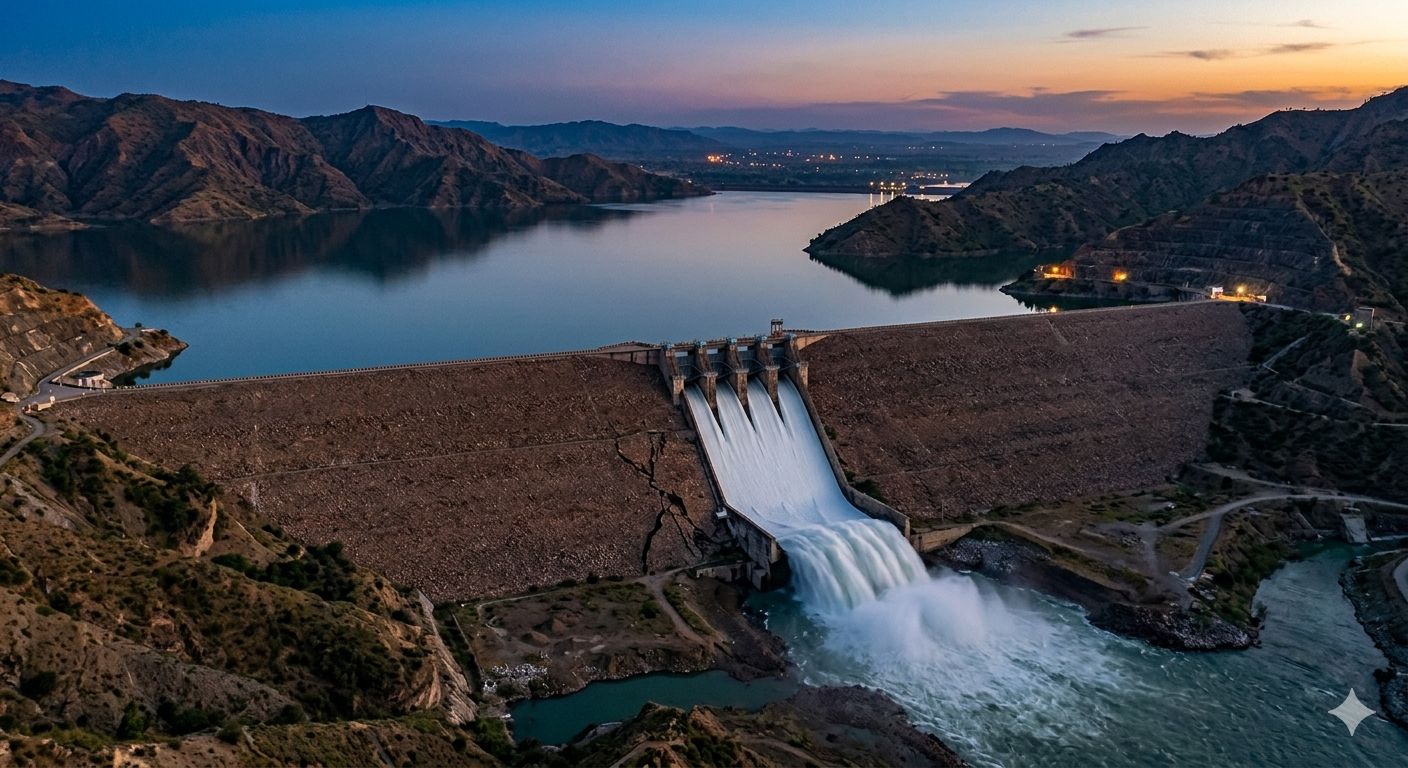
Pakistan will come to the table. It has no other option. An India that controls the timing and quantum of flows into Tarbela is an India with leverage that no international tribunal, no World Bank mediator, and no American diplomatic note can negate. At that table, India will offer water — not as charity but as the price of a verified, permanent, and irreversible peace. The era of one-sided concessions is over. The era of sovereign water stewardship — and with it, sovereign bargaining — has begun.
Ravi Power: Ranjit Sagar Dam stands out as a glorious symbol of India utilising part of its allocated waters.

Time is the one resource that cannot be recovered. The glaciers retreat. The aquifers fall. Every monsoon season that passes without a Marhu Tunnel in the ground is a season of lost opportunity and accumulated strategic deficit. The projects must begin. The authority must be constituted. The funds must be allocated. The Parliament must legislate.

India has, for the first time in sixty-five years, both the legal space and the political will to act. It must not waste either.


Tags: Foreign Policy Diplomacy International Relations India Pakistan IWT Indus Water Treaty WorldBank Ravi Beas Sutlej Jhelum Chenab Sindhu WaterDiplomacy
ShareTweetShareSend
KBS Sidhu

KBS Sidhu

KBS Sidhu, is a former Special Chief Secretary of Punjab. He is an MA in Economics from the Manchaster University. He writes of geopolitics, economy, terrorism, human rights, South Asian geo-stability and the intersection of trade policy and Trump-era tariff tactics.

Related Posts

Protecting Consumers from Smuggling and Counterfeiting in India: A Strategic Imperative
Internal Security

Protecting Consumers from Smuggling and Counterfeiting in India: A Strategic Imperative

April 22, 2026
Mapping Multi-Stage Attack Behaviours to Wazuh Alerts Using MITRE ATT&CK
Internal Security

Mapping Multi-Stage Attack Behaviours to Wazuh Alerts Using MITRE ATT&CK

April 20, 2026
USTAADS OF NPA
Internal Security

USTAADS OF NPA

April 20, 2026
Narco-Terrorism and Organised Crime in the Pakistan–Afghanistan Region: Security Implications for India
Foreign Policy

Narco-Terrorism and Organised Crime in the Pakistan–Afghanistan Region: Security Implications for India

April 16, 2026

JUN-AUG 2025 ISSUE

ADVERTISEMENT

Trending Articles

The Indus Waters Treaty: A Gentleman’s Agreement with a Terrorist State
Economy

The Indus Waters Treaty: A Gentleman’s Agreement with a Terrorist State

byKBS Sidhu
April 25, 2026
Protecting Consumers from Smuggling and Counterfeiting in India: A Strategic Imperative
Internal Security

Protecting Consumers from Smuggling and Counterfeiting in India: A Strategic Imperative

byAnil Rajput
April 22, 2026
Mapping Multi-Stage Attack Behaviours to Wazuh Alerts Using MITRE ATT&CK
Internal Security

Mapping Multi-Stage Attack Behaviours to Wazuh Alerts Using MITRE ATT&CK

byDevansh Gulati
April 20, 2026
USTAADS OF NPA
Internal Security

USTAADS OF NPA

bySachin Shridhar
April 20, 2026

About Saviours - Voice of Khaki

Saviours: Voice of Khaki (SVOK) aims to be the first ever platform in the Country for the men in khaki whether in the Police or Prisons or Central Armed Police Forces (CAPFs) through which they can voice their issues as well.

Quick Links

  • Home
  • About Us
  • Refund Policy
  • Privacy Policy
  • Terms and Conditions
  • Advertise With Us
  • Contact Us

Topics

  • Policing
  • Border Management
  • CAPFs
  • Corrections
  • Internal Security
  • Mod & Tech
  • Narcotics
  • Naxalism
  • Disaster Management
  • Interviews
  • Videos

Connect With Us

For PR Agencies & Content Writers: marketing@savioursmagazine.in

Connect With Us

Facebook Twitter Youtube Linkedin

© 2025 Designed by AK Network Solutions

Welcome Back!

Login to your account below

Forgotten Password? Sign Up

Create New Account!

Fill the forms below to register

All fields are required. Log In

Retrieve your password

Please enter your username or email address to reset your password.

Log In
No Result
View All Result
  • About Us
  • Advertise With Us
  • Cart
  • Checkout
  • Contact Us
  • Home
  • My account
  • Privacy Policy
  • Refund Policy
  • Subscribe
  • Terms and Conditions

© 2022 Designed by AK Network Solutions

Are you sure want to unlock this post?
Unlock left : 0
Are you sure want to cancel subscription?