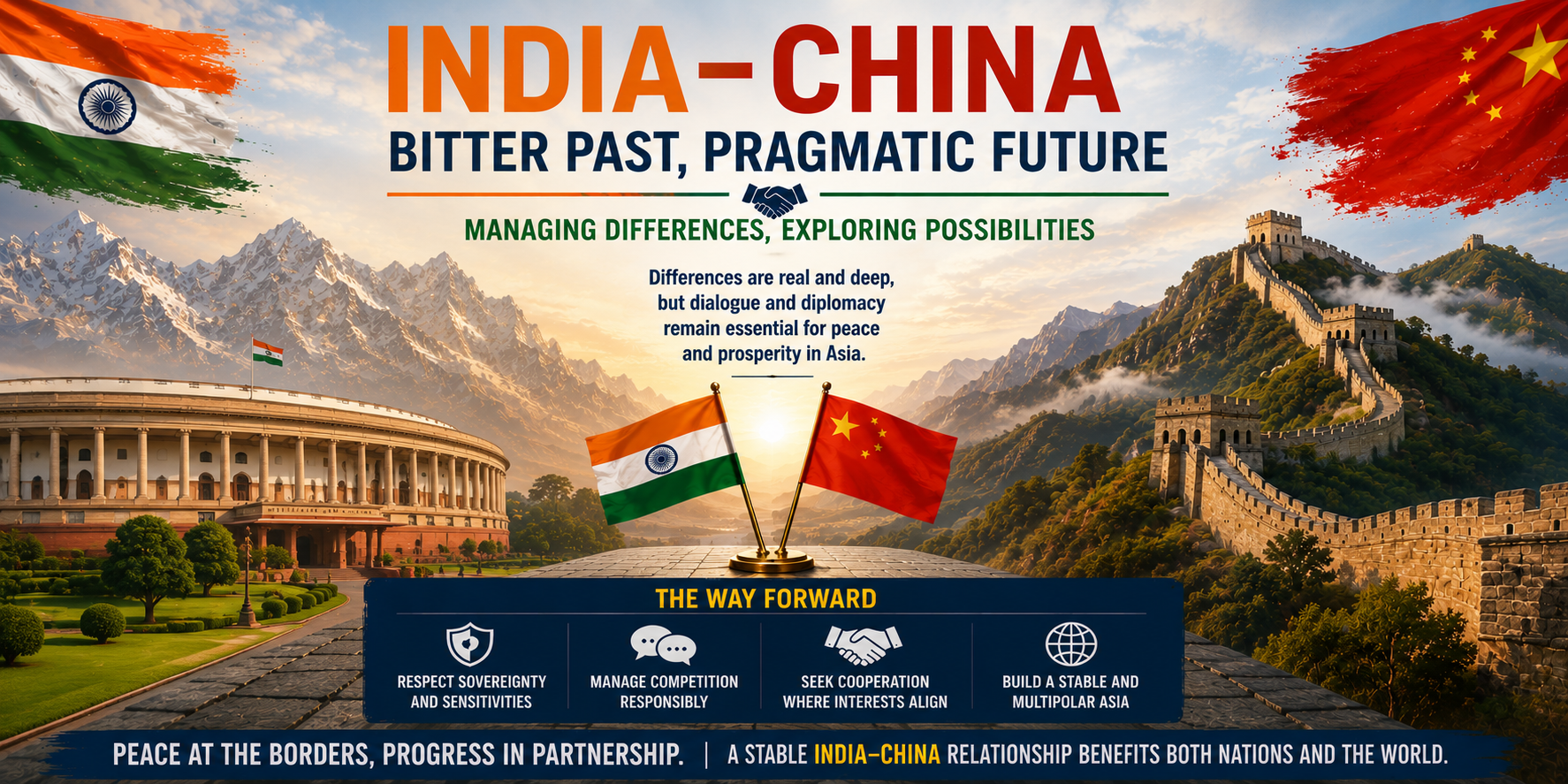
India’s security environment has entered a more demanding phase. The challenge posed by China is no longer limited to a disputed land frontier or occasional diplomatic friction. It now stretches from the Himalayas to the Indian Ocean, encompassing military infrastructure, coercive diplomacy, port access, maritime surveillance, technology, and influence in India’s neighbourhood. The old assumption that border tensions could be managed separately from the broader bilateral relationship has broken down. India, therefore, requires a strategy that is not reactive, symbolic or episodic but layered, sustained and rooted in long-term state capacity. This article argues that India’s best response lies in combining denial on the land frontier, sharper maritime leverage, faster delivery in the neighbourhood, selective external balancing and accelerated defence-industrial and technological strengthening.
Introduction
The challenge posed by China is no longer limited to a disputed land frontier or occasional diplomatic friction. It now stretches from the Himalayas to the Indian Ocean, encompassing military infrastructure, coercive diplomacy, port access, maritime surveillance, technology, and influence in India’s neighbourhood. The old assumption that border tensions could be managed separately from the broader bilateral relationship has lost its meaning. Since 2020, Indian official statements have repeatedly acknowledged that peace and tranquillity along the border are indispensable for normal relations and that Chinese actions have disrupted the basis of ties. This shift is fundamental. India now faces not a temporary crisis, but a structural contest.
Even where tactical de-escalation has occurred, strategic trust has not returned. The October 2024 disengagement arrangements and subsequent India-China diplomatic contacts helped stabilise parts of the frontier, and the 23rd meeting of the Special Representatives in December 2024 signalled a desire to maintain dialogue. Yet Indian official statements describe the relationship as abnormal since 2020, while external assessments continue to note substantial Chinese force levels and infrastructure along the Line of Actual Control (LAC). A sober reading is unavoidable; immediate temperature may have fallen, but the underlying conflict remains alive.
India’s challenge is also larger than military deployments alone. Chinese activities around India involve coordinated pressure across multiple domains, including force posture along the Himalayas, expanding naval and research presence in the Indian Ocean, political and economic penetration in India’s neighbourhood and technological advances that shape the long-term balance of power. India, therefore, needs more than crisis management. It needs a full-spectrum competitive strategy.
From Border Crisis to Long-Term Strategic Competition
The core mistake in much of the Indian debate is treating China as a border management problem. That is too narrow. China has built a much broader competitive position. The US Department of Defence’s 2024 report states that the PLA’s Western Theatre Command remains oriented toward India and that China has developed infrastructure and force posture improvements to support operations along the frontier. That matters because it suggests a model of long-duration coercion, negotiations above the table, pressure on the ground and logistics in place for persistence. India is not dealing with a one-off military standoff; it is dealing with a rival that has normalised permanent leverage.
The power balance is also being shaped by scale. SIPRI estimates that China spent about $314 billion on its military in 2024, compared with India’s $86.1 billion. Beijing’s nuclear modernisation is also accelerating. SIPRI estimates China’s nuclear arsenal at at least 600 warheads, while the Pentagon assesses that China had surpassed 600 operational nuclear warheads as of mid-2024 and is on course for further expansion. India does not need to match China rupee-for-yuan or warhead-for-warhead; that would be a fantasy. But it does need to recognise what this disparity means in practice. China enjoys greater room for military experimentation, infrastructure build-up, naval expansion, and technological integration across domains.
This widening gap is precisely why complacent narratives are dangerous. A strategy based on diplomatic atmospherics, summit optics, or generic appeals to strategic autonomy is not enough. China’s advantage lies in its ability to integrate military modernisation, industrial production, infrastructure, diplomacy and external access into a single strategic approach. India’s answer must be systemic as well. Tanvi Madan has argued that India’s view of China has shifted decisively from guarded engagement to open competition, driven not only by the border dispute but also by Beijing’s broader ambitions in South Asia and the Indian Ocean.
Chinese Activities Around India: A Multi-Domain Challenge
The Himalayan Frontier
On land, China’s objective is not necessarily a major war; it is controlled coercion. The frontier allows Beijing to impose costs on India, tie down military resources, test political resolve and keep uncertainty alive. Indian official statements show that it continues to treat border peace as a prerequisite for broader normalcy. That formulation is strategically sound, but it also reveals vulnerability. China can influence the entire relationship merely by keeping the border unsettled. This gives Beijing a pressure point that can be activated or softened depending on wider political calculations.
Moreover, the frontier is now shaped by competition in infrastructure. Roads, bridges, tunnels, surveillance, logistics nodes, and winter sustenance systems determine whether military presence becomes a credible deterrent or merely expensive symbolism. China has already demonstrated a willingness to use its infrastructure edge for rapid military mobilisation. India has improved since 2020, but the race is not over.
The Indian Ocean
At sea, the Chinese challenge is becoming more subtle and, in some ways, more dangerous. Chinese research vessels, fishing fleets and naval deployments are expanding Beijing’s informational and operational footprint in the Indian Ocean Region (IOR). Carnegie India has warned that Chinese presence in the IOR now includes warships, fishing vessels, research platforms and underwater surveillance networks, creating conditions for grey-zone competition and future strategic leverage. Reuters reported in March 2026 that Chinese research vessels have been mapping strategically important stretches of the ocean floor to support undersea warfare capabilities, including better knowledge of currents, seabed terrain and acoustic conditions. This is not harmless science. It is maritime preparation with civilian cover.
China’s challenge in the Indian Ocean is not immediate dominance. It is patient ecosystem-building. By normalising naval visits, dual-use research, commercial access, and maritime data collection, Beijing is positioning itself for deeper future leverage. Once this ecosystem matures, India’s operating burden rises sharply. The combination of Chinese maritime activity with Pakistan’s geographic utility further complicates India’s western maritime flank.
The Neighborhood and Strategic Access
China’s activities around India are also political and geographic. Through infrastructure projects, economic relationships, digital ecosystems and strategic access arrangements, Beijing has steadily expanded its room for manoeuvre in South Asia and the wider Indian Ocean. Indian official responses have increasingly emphasised defence ties, maritime cooperation, development partnerships and the MAHASAGAR framework precisely because New Delhi understands that the contest is not only military. India’s neighbourhood is no longer a diplomatic comfort zone. It is a competitive arena where delay, neglect, or under-delivery can translate into strategic loss.
That is the harsh reality Indian policy often prefers not to state plainly. Smaller states in South Asia and the Indian Ocean do not want to become anti-China platforms for India. They want options, financing, capacity-building and reliable partners. India’s leverage depends not on rhetoric about civilizational ties, but on whether it can deliver faster and more credibly than China when it matters.
There could be more to the Indian Response
India has responded with greater seriousness since 2020, but the response remains uneven. Border infrastructure has improved, naval capability is growing, and policy language has become more realistic. The Ministry of Defence declared 2025 the “Year of Reforms,” explicitly highlighting integrated theatre commands, modernised acquisition, emerging technologies and multi-domain capability. The government has also highlighted a wider reform push and continuing investment in border and military infrastructure. These are useful steps. But useful is not the same as sufficient. India needs more speed, scale, and institutional follow-through.
India often announces a strategy faster than it executes it. That gap is strategically expensive. China benefits when Indian procurement is slow, inter-service coordination is fragmented, neighbourhood projects are delayed, and domestic manufacturing falls short of operational urgency. In a prolonged rivalry, bureaucratic delay is not a minor administrative defect. It becomes a national security liability.
Strategic Option I: Build a Credible Denial Strategy on the Land Frontier
India’s first priority should be deterrence by denial along the LAC. This means making it difficult for China to secure surprise, impose local military facts, or convert tactical pressure into political leverage. That requires more than troop presence. It requires hardened logistics, all-weather connectivity, forward stockpiles, airlift capacity, long-range precision fires, ISR integration, drone networks, electronic warfare resilience, and survivable communications. The objective is not to mirror-image China sector by sector, which would be a waste of resources. The objective is to ensure that any Chinese attempt to alter the status quo faces immediate friction, high uncertainty, and operational delay.
This also strengthens the case for genuine theatre reform. India cannot afford to fight in compartments while China plans in systems. If the frontier remains militarised in the long term, land, air, cyber, space, and intelligence assets must be coordinated through a better approach than ad hoc crisis management. The idea is simple: if China aims to sustain leverage over time, India must ensure that maintaining that leverage becomes expensive.
Strategic Option II: Shift from Maritime Presence to Maritime Leverage
India’s second major option lies at sea. China is still geographically disadvantaged in the Indian Ocean compared with India, but that advantage will erode if India confuses visibility with leverage. Naval port calls and symbolic deployments are not enough. India’s real maritime advantage lies in sea denial, maritime domain awareness, anti-submarine warfare, undersea surveillance and its geographic position across critical sea lanes. In this context, Chinese survey activity, undersea mapping, and dual-use maritime operations should be read as early-stage preparations for future leverage rather than as isolated episodes. India must respond by investing in the information layer of maritime power, seabed awareness, undersea sensors, long-endurance surveillance, coastal fusion centres, partner data-sharing and resilient undersea cable protection.
This is also where the Andaman and Nicobar position becomes central. India does not need to dominate every ocean space. It needs to shape key maritime corridors and understand them better than any external power. The 2025 Quad Foreign Ministers’ process and related initiatives on maritime domain awareness, training and regional coordination are useful because they help construct a common operating picture in the Indo-Pacific.
Strategic Option III: Compete Harder in the Neighbourhood
India’s third option is to stop treating the neighbourhood as a sentimental category and start treating it as a strategic theatre. South Asian and Indian Ocean states do not want to be forced into anyone’s camp. They want infrastructure, financing, disaster support, coast guard cooperation, training, digital connectivity and political respect. China has exploited gaps in all these areas. India’s answer, reflected in Ministry of External Affairs statements on strategic partnerships and MAHASAGAR, is to combine defence and maritime security cooperation with economic and developmental support. That is the correct framework. The problem is that India often delivers too slowly.
The Mauritius example shows what India should scale up. During Prime Minister Modi’s March 2025 visit, India and Mauritius emphasised defence cooperation, maritime security, support for Mauritius’ Exclusive Economic Zone, coast guard needs, and a broader strategic partnership within the expanded regional vision. That is the model, practical security support tied to development. In strategic competition, a delayed Indian bridge, radar project, power link, or patrol vessel is not just an administrative lapse; it is a strategic opening for China.
Strategic Option IV: Deepen External Balancing Without Losing Strategic Autonomy
India’s fourth option is selective external balancing. This does not mean alliance dependence. It means using partnerships to quickly narrow capability gaps, where India cannot afford delay. The Quad’s 2025 agenda included maritime security, domain awareness, critical and emerging technologies, humanitarian coordination and economic security initiatives. The February 2025 US-India Joint Leaders’ Statement also underscored defence cooperation, trade expansion, supply-chain resilience, and broader strategic coordination. These arrangements matter because India’s contest with China now spans technologies, logistics, undersea space, critical minerals, and supply chains and not just border positions.
The right Indian posture is disciplined pragmatism. Work with the United States for undersea warfare, ISR, logistics, and advanced technologies. Work with France in the western Indian Ocean. Work with Japan on infrastructure and supply-chain resilience. Use the Quad for maritime coordination and standards. But keep decision-making Indian. Strategic autonomy is worthless if it becomes an excuse for strategic under-preparedness. It is only meaningful when backed by real capability.
Strategic Option V: Accelerate Defence-Industrial and Technological Capacity
India’s fifth option is internal, build faster. China’s real strength lies not only in military spending but also in production capacity and civil-military integration. India’s defence challenge, therefore, is industrial as much as operational. SIPRI notes both India’s high expenditure and its continuing dependence in some major sectors, even as domestic procurement has expanded. Indian reforms and shipbuilding milestones, including the commissioning of INS Surat, INS Nilgiri and INS Vaghsheer, show that progress is real.
India needs a much harder-edged approach, faster procurement cycles, deeper private-sector integration, clearer production priorities, long-term ammunition and spares planning, maintenance resilience and willingness to use foreign collaboration where it buys time and know-how. Ideological arguments over self-reliance versus external partnership are stale. India needs both. What matters is whether systems arrive on time, at scale, and can be sustained under prolonged pressure.
Strategic Option VI: Keep Talking to China, but Drop the Illusions
The final option is diplomatic discipline. India should continue to use diplomatic and military channels with China because crisis management matters, and miscalculation is dangerous. The Special Representatives’ mechanism, WMCC contacts, and political dialogue remain useful. But usefulness should not be confused with resolution. India should not chase a performative reset if the underlying military posture remains adverse. The correct approach is controlled engagement, cooperate where necessary, communicate constantly and negotiate seriously, but do not allow dialogue to anaesthetise strategy.
China is unlikely to abandon pressure simply because bilateral meetings resume or trade remains large. Beijing has demonstrated that it can compartmentalise, sequence pressure and exploit time. India must do the same in reverse, stabilise where possible, compete where necessary and prepare for a long contest rather than episodic crisis management.
Conclusion
India’s strategic choice is not between reckless confrontation and passive accommodation. It is between shallow response and serious statecraft. China’s activities around India now form a clear pattern: sustained frontier pressure, rising maritime presence, undersea data collection, growing strategic access in the neighbourhood, and expanding capability backed by industrial scale. India’s response must therefore be equally integrated. It needs denial on land, leverage at sea, delivery in the neighbourhood, selective balancing abroad and industrial acceleration at home.
The good news is that India retains major strengths, including a central location in the Indian Ocean, political legitimacy, diplomatic flexibility, credible armed forces, and growing partnerships. The bad news is that none of these strengths automatically converts into a strategic advantage. That conversion requires speed, discipline and sustained execution. If India gets serious, it can prevent China from converting regional presence into regional dominance. If it does not, then the problem will not be a lack of warning. It will be a lack of follow-through.
Bibliography
1. Brookings. “India’s Competitive Turn Toward China.” By Tanvi Madan. February 26, 2026.
2. Jaishankar, S. “Statement by External Affairs Minister, Dr S. Jaishankar in Lok Sabha.” Ministry of External Affairs, Government of India. December 3, 2024.
3. Kumar, Ajay, and Charukeshi Bhatt. “Hidden Tides: IUU Fishing and Regional Security Dynamics for India.” Carnegie India. June 23, 2025.
4. Liang, Xiao, Nan Tian, Diego Lopes da Silva, Lorenzo Scarazzato, Zubaida A. Karim, and Jade Guiberteau Ricard. Trends in World Military Expenditure, 2024. Stockholm: SIPRI, April 2025.
5. Ministry of Defence, Government of India. “Ministry of Defence Declares 2025 as ‘Year of Reforms.’” Press Information Bureau. January 1, 2025.
6. “Ministry of Defence; Year End Review – 2025.” Press Information Bureau. December 31, 2025.
7. Ministry of External Affairs, Government of India. “23rd Meeting of the Special Representatives of India and China.” Press release. December 18, 2024.
8. “Factsheet: 2025 Quad Foreign Ministers’ Meeting in Washington D.C. (July 01, 2025).” July 2, 2025.
9. “India-Mauritius Joint Vision for an Enhanced Strategic Partnership.” March 12, 2025.
10. “Question No. 3101: India’s Strategic Partnerships to Address Emerging Geopolitical Challenges.” Rajya Sabha. Answered March 27, 2025.
11. “English Translation of Press Statement by Prime Minister during the India-Mauritius Joint Press Statement.” March 12, 2025.
12. Prime Minister’s Office, Government of India. “PM Dedicates Frontline Naval Combatants INS Surat, INS Nilgiri & INS Vaghsheer to the Nation.” January 15, 2025.
13. The White House. “United States-India Joint Leaders’ Statement.” February 13, 2025.
14. U.S. Department of Defense. Military and Security Developments Involving the People’s Republic of China 2024. Washington, DC: Department of Defense, 2024.