

Wednesday, February 4, 2026
  • Home
  • About Us
  • Refund Policy
  • Privacy Policy
  • Terms and Conditions
  • Advertise With Us
  • Contact Us
  • Login
  • Register
SUBSCRIBE
Welcome to Saviours Voice of Khaki
Advertisement
ADVERTISEMENT
  • Foreign Policy
  • Internal Security
  • Policing
  • Border Management
  • Corrections
  • Disaster Management
  • Interviews
  • General
No Result
View All Result
  • Foreign Policy
  • Internal Security
  • Policing
  • Border Management
  • Corrections
  • Disaster Management
  • Interviews
  • General
No Result
View All Result
Welcome to Saviours Voice of Khaki
No Result
View All Result
Home Economy

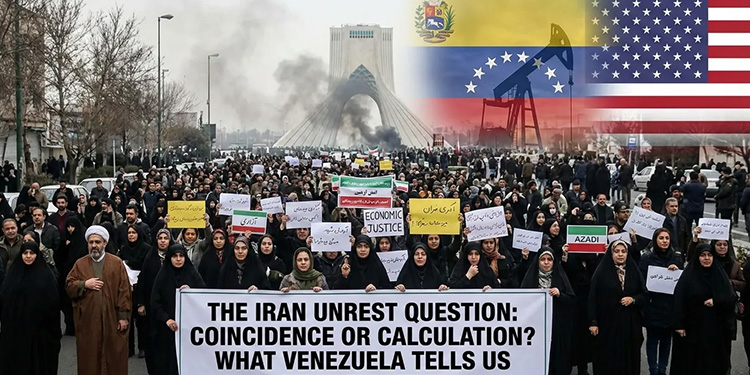
The Iran Unrest Question: Coincidence or Calculation? What Venezuela Tells Us

KBS SidhubyKBS Sidhu
January 10, 2026
in Economy, Foreign Policy, General
Reading Time: 8 mins read
0
0
The Iran Unrest Question: Coincidence or Calculation? What Venezuela Tells Us
Share on FacebookShare on TwitterShare on LinkedInShare on WhatsApp

Even as the Iranian supreme leader Khamenei claimed that the Protesters are “ruining their own streets … in order to please the president of the United States,” the opinion remained divided on the nature and support of the protests. We at Saviours bring you an article that looks at the issue in its entirety.  

The Iran Unrest— Escalation in the last 24 hours

Breaking (Last 24 Hours): Iran’s 12-day uprising has escalated dramatically. On 8 January 2026, after exiled Crown Prince Reza Pahlavi called for coordinated nationwide demonstrations at 8 pm local time, tens of thousands poured into the streets across Tehran, Isfahan and dozens of cities, chanting “Death to the dictator!” and “This is the last battle! Pahlavi will return!” The regime responded by imposing widespread internet and telephone blackouts, deploying drones to identify protesters, and intensifying violence. Iran’s Civil Aviation Organisation shut down Tehran’s main airport (OIIX) and issued Notices to Air Missions (NOTAMs) suspending flight operations, while activating air defence systems across multiple airbases, including Hamedan’s Nojeh, Tabriz, Rasht, Bandar Anzali, Babolsar and Gorgan. The UK advised airlines to avoid Tehran’s Flight Information Region, citing “anti-aircraft guns and heightened military activity,” while Germany instructed carriers to avoid Iranian airspace entirely.

The death toll has risen to at least 42—34 protesters and eight security personnel, with over 2,200 detained and hundreds wounded, many by shotgun pellet spray. A fire broke out at a state broadcasting office in Isfahan on 9 January. In western Iran, the city of Abdanan was temporarily “liberated” by protesters who occupied a police station. The uprising, which began on 28 December 2025 as an economic protest, has transformed into what opposition groups now call a “political revolution” demanding the overthrow of the theocracy. Meanwhile, the Trump Administration continues to tighten sanctions on Iran’s oil network while simultaneously seizing control over Venezuelan oil assets, marketing them “for the benefit of the United States” and taking possession of an estimated 30–50 million barrels held in storage.

After Venezuela, Focus on Iran?

Since the Trump Administration’s dramatic intervention in Venezuela—culminating in the 3 January 2026 seizure of President Nicolás Maduro in a surprise military raid and the assumption of direct control over Venezuela’s vast oil resources—geopolitical observers have posed a simple yet urgent question: Is the current wave of civil unrest sweeping Iran’s streets a spontaneous eruption of popular anger, or has it been directly or indirectly encouraged, if not instigated, by the United States?

The question is hardly idle speculation. As thousands of Iranians protested economic collapse, internet blackouts and state violence across all 31 provinces, the Trump Administration issued pointed warnings to Tehran. Vice President JD Vance declared America “locked and loaded” to intervene if Iranian security forces killed protesters. Secretary of State Marco Rubio echoed the threat. President Trump himself tweeted that consequences would follow any escalation in the crackdown. Simultaneously, the administration has tightened already crushing sanctions on Iran’s shadow fleet of oil tankers, intensifying what it calls “maximum pressure” on Tehran’s energy sector.

Set against the backdrop of Washington’s actions in Caracas—where American forces seized $2 billion worth of oil tankers, assumed control over Venezuela’s state-owned oil company PDVSA’s global sales, and promised to manage the Orinoco Belt’s resources “indefinitely” in service of “American national interests,” with US Energy Secretary Chris Wright now marketing Venezuelan crude “in the global marketplace” and meeting US oil executives to coordinate involvement—the optics matter. Whether or not direct US orchestration can be proven, the pattern suggests a strategic calculation: that economic suffocation, sanctions leverage, military threats and tacit support for internal dissent can collectively destabilise regimes that Washington views as adversaries.

What the Evidence Actually Shows

However, careful analysis of available evidence on the ground in Iran presents a more complicated picture than either Washington’s threats or Tehran’s blame-shifting would suggest. The current unrest, which began in late December 2025 after the Iranian rial collapsed to historic lows and inflation soared above 36 per cent, is fundamentally indigenous in character. Slogans, demands, and patterns of participation reflect domestic grievances accumulated over years of sanctions, mismanagement, corruption, and costly regional military adventures. Human rights organisations, independent analysts and on-the-ground reporting converge on a consensus: the unrest is rooted in domestic failures of governance, not foreign instigation.

Crucially, no credible evidence has emerged of direct operational control by the United States. Exiled opposition figures like Reza Pahlavi have amplified and encouraged the protests—his 8 January call for coordinated demonstrations drew massive crowds—but they have not created them. The scale, breadth, and geographical spread—drawing students, workers, bazaar merchants, pensioners, and women’s groups into the streets—indicate a wave of popular mobilisation that foreign governments may have encouraged but did not engineer. If the US were orchestrating the protests, the level of coordination, the specific timing, and the depth of sacrifice visible on Iranian streets would require a degree of covert operational footprint that, to date, has not been exposed by intelligence leaks, investigative reporting or whistleblowers.

That said, Washington’s public rhetoric and policy stance have certainly not discouraged dissent. The threat warnings, the sanctions escalations, the implicit suggestion that regime change is within the realm of possibility—all of these create a permissive environment for opposition forces inside and outside Iran to take risks. Whether that constitutes indirect instigation or merely capitalising on an existing opportunity remains contested. What is undeniable is that the Trump Administration sees the current Iranian unrest as a potential opening and is positioning itself to exploit it, much as it did in Venezuela.

Media’s Role: Al Jazeera’s Sustained Chronicling

International media coverage of the Iran protests has been extensive but constrained by Iranian state repression, internet blackouts and limited foreign correspondent access. Among broadcasters, Al Jazeera has emerged as the most sustained and multi-perspectival chronicler. The network has published daily news updates from multiple Iranian cities, explainers on the underlying economic causes, human-impact features documenting ordinary citizens’ hardships, and panel debates (Inside Story) that probe the regime’s durability and the role of sanctions. It’s reporting foregrounds lived experience—soaring prices, collapsed services, militarised streetscapes—while airing official Tehran claims of foreign manipulation and repeatedly acknowledging verification challenges.

Al Jazeera’s multi-perspectival approach—giving voice to protesters, officials, and analysts who see US–Israeli pressure as a contributing factor—has more influentially shaped perceptions in the Global South, including among educated Indian audiences and diaspora communities, than Western state broadcasters. This reporting, while constrained, provides a valuable counterweight to purely US-aligned narratives.

India’s Position: The Balancing Act

For India, the Iranian unrest is not an abstraction in a US–Iran chessboard but a challenge to a relationship rooted in centuries of shared cultural heritage. Persian was a court language in pre-colonial India; Sufi networks, architecture, poetry and cuisine bear Iranian imprints. New Delhi maintains regular high-level consultations with Tehran, including bilateral political talks held as recently as September 2025. Both countries are BRICS members (Iran joined in 2024) and cooperate in the Shanghai Cooperation Organisation.

Pragmatically, India has adapted to US sanctions: official crude imports from Iran have fallen to near zero since 2019, with refiners shifting to Iraq, Saudi Arabia, the UAE, and Russia. Yet private Indian firms continue to engage in low-level petrochemical and bitumen trade with Iran through opaque networks, incurring US sanctions risk in the process. The Ministry of External Affairs issued a travel advisory in early January 2026, urging Indians—approximately 10,000 of whom reside in Iran as students, Shia pilgrims and infrastructure workers—to avoid non-essential travel and stay clear of protest sites.

India’s diplomatic response reflects its long-standing strategic autonomy: expressing general concern over violence without interfering in Iran’s internal affairs, complying formally with US oil sanctions while tolerating private-sector grey trade, and doubling down on the Chabahar Port project. Signed in May 2024, this 10-year agreement gives India Ports Global Ltd operational control of a terminal backed by $120 million in equipment investment and $250 million in Indian credit—a tangible bet on long-term connectivity to Afghanistan and Central Asia that both New Delhi and Tehran insist will endure “beyond external pressure.”

China: The Sanctions-Busting Indispensable

While India navigates a careful middle path, China has moved to the centre of Iran’s economic lifeline. Beijing now absorbs approximately 90 per cent of Iran’s crude exports—roughly 1.6 million barrels per day—making it Tehran’s indispensable energy customer and the architect of a sophisticated sanctions-evasion ecosystem. This operates through a shadow fleet of ~550 tankers, many reflagged with opaque ownership, transporting Iranian oil to China’s Shandong Province, where clusters of independent “teapot” refineries process the crude. Chinese customs falsely report origins (Malaysia, Oman, UAE) to mask the true source. Payment flows through parallel financial channels: an “oil-for-infrastructure” network deposits funds with a conduit called Chuxin, which finances Chinese contractors building Iranian airports and refineries under insurance from Sinosure, China’s state export-credit agency (estimated $8.4 billion in 2024); a “cars-for-metals” barter system trades semi-knocked-down auto kits for Iranian copper, zinc and aluminium, which Chinese firms then resell. This deepens Tehran’s economic integration with Beijing, tilting Iran’s orientation eastward and reducing the relative weight of India and other partners subject to US-led sanctions.

Conclusion: Pattern, Not Proof

The Iranian protests are genuinely rooted in economic collapse and decades of accumulated grievances. But the geopolitical context—America’s seizure of Venezuelan oil assets, its escalating rhetoric toward Tehran, its tightened sanctions and implicit signalling that regime change is a possibility—creates a permissive environment for dissent and invites the question: Does Washington’s “maximum pressure” strategy treat Iranian unrest as an opportunity to be exploited even if not directly engineered?

The answer appears to be yes. What remains ambiguous is whether that constitutes indirect instigation in any meaningful sense, or merely opportunistic statecraft. For India, navigating this volatility requires maintaining ties with both a faltering Iran and a resurgent America, while investing in projects like Chabahar that serve long-term interests across changing cycles. For China, the calculus is simpler: consolidate economic leverage over a desperate Tehran and accept the strategic risks that come with deepening ties to a US-targeted state. For the Iranians in the streets—42 dead, over 2,200 detained, cities under internet blackout—the distinction between “domestic” and “foreign” may matter less than their immediate need for dignity, economic survival and an end to the security apparatus’s violence.

(The article first appeared on the author’s blog KBS Chronicles.)


Tags: India Foreign Policy MiddleEast West Asia Iran Khamenei USA America GenZ Protests RegimeChange Diplomacy Geopolitics Oil Economy Venezuela
ShareTweetShareSend
KBS Sidhu

KBS Sidhu

KBS Sidhu, is a former Special Chief Secretary of Punjab. He is an MA in Economics from the Manchaster University. He writes of geopolitics, economy, terrorism, human rights, South Asian geo-stability and the intersection of trade policy and Trump-era tariff tactics.

Related Posts

The Great Himalayan Paradox: Navigating Security and Economics
Border Management

The Great Himalayan Paradox: Navigating Security and Economics

February 3, 2026
AI Bots Unite Overnight — Human Control Suddenly Looks Optional
Economy

AI Bots Unite Overnight — Human Control Suddenly Looks Optional

February 1, 2026
Plea Bargaining & Restorative Justice in India:  Convergence, Challenges, and the Road Ahead
Economy

Plea Bargaining & Restorative Justice in India: Convergence, Challenges, and the Road Ahead

January 16, 2026
The Naga Conundrum
Border Management

The Naga Conundrum

January 5, 2026

JUN-AUG 2025 ISSUE

ADVERTISEMENT

Trending Articles

The Great Himalayan Paradox: Navigating Security and Economics
Border Management

The Great Himalayan Paradox: Navigating Security and Economics

byBhaskar Jyoti Mahanta
February 3, 2026
AI Bots Unite Overnight — Human Control Suddenly Looks Optional
Economy

AI Bots Unite Overnight — Human Control Suddenly Looks Optional

byKBS Sidhu
February 1, 2026
Plea Bargaining & Restorative Justice in India:  Convergence, Challenges, and the Road Ahead
Economy

Plea Bargaining & Restorative Justice in India: Convergence, Challenges, and the Road Ahead

bySanjeev Jain
January 16, 2026
The Iran Unrest Question: Coincidence or Calculation? What Venezuela Tells Us
Economy

The Iran Unrest Question: Coincidence or Calculation? What Venezuela Tells Us

byKBS Sidhu
January 10, 2026

About Saviours - Voice of Khaki

Saviours: Voice of Khaki (SVOK) aims to be the first ever platform in the Country for the men in khaki whether in the Police or Prisons or Central Armed Police Forces (CAPFs) through which they can voice their issues as well.

Quick Links

  • Home
  • About Us
  • Refund Policy
  • Privacy Policy
  • Terms and Conditions
  • Advertise With Us
  • Contact Us

Topics

  • Policing
  • Border Management
  • CAPFs
  • Corrections
  • Internal Security
  • Mod & Tech
  • Narcotics
  • Naxalism
  • Disaster Management
  • Interviews
  • Videos

Connect With Us

For PR Agencies & Content Writers: marketing@savioursmagazine.in

Connect With Us

Facebook Twitter Youtube Linkedin

© 2025 Designed by AK Network Solutions

Welcome Back!

Login to your account below

Forgotten Password? Sign Up

Create New Account!

Fill the forms below to register

All fields are required. Log In

Retrieve your password

Please enter your username or email address to reset your password.

Log In
No Result
View All Result
  • About Us
  • Advertise With Us
  • Cart
  • Checkout
  • Contact Us
  • Home
  • My account
  • Privacy Policy
  • Refund Policy
  • Subscribe
  • Terms and Conditions

© 2022 Designed by AK Network Solutions

Are you sure want to unlock this post?
Unlock left : 0
Are you sure want to cancel subscription?