

Police occupation presents tricky situations, sometimes life-threatening or life-taking. Police officers, more often than not, find themselves at the moral crossroads. This essay advises what they should do so as not to cross the Lakshman Rekha.
What happens when the cop has dirty hands?
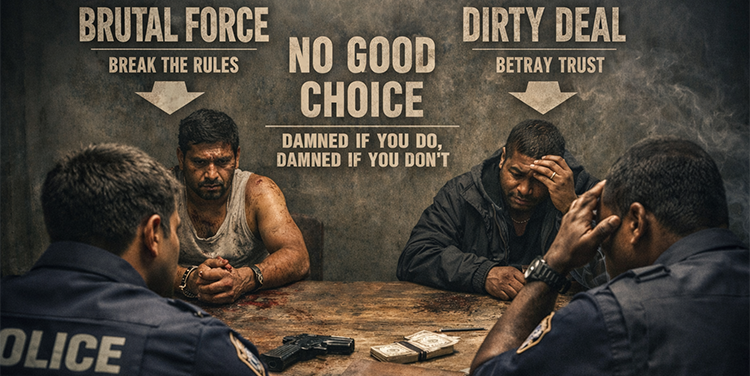
What I’m talking about is not physical grime but situations of ethical dilemmas. It’s very easy to tell people and to police trainees to “be good, do good,” “do the right thing, always,” “do the right thing, even when no one is looking,” and so on. The problem is that, many times, the cop is faced with choices where any alternative chosen has unethical implications, but the cop has to choose one. These are called the Wrong-vs-Wrong choices. Whatever alternative is chosen leaves the cop’s hands dirty. That is why this set of problems is collectively called “the problem of the dirty hands.”
Let’s take a hypothetical example, some variation of which is all too common in a cop’s life.
There is information that a few devastating bombs have been planted in a crowded locality, and, on suspicion, a hardened terrorist with a high probability of having committed the crime has been arrested. He is denying it, and the bombs are likely to go off in short order. What does the cop do?
What are his options? If he takes the terrorist at face value and the bombs go off, many innocents would die, and he would have serious blood on his hands. On the other hand, he might try to extract information from the terrorist. He doesn’t have time for sustained enquiry, hence some amount of what is euphemistically called “enhanced interrogation” may be required. That is a serious violation of the human rights of the person apprehended on suspicion.
Since the accused is a hardened terrorist, the interrogation needs to be harsh and might just result in his death. Finally, there may be no information elicited, or he might be innocent of this particular crime despite his antecedents. Thus, whatever option the cop chooses will be grossly unethical, and he will come out of it with his hands dirty. This is a classic “dirty hands dilemma.”
There is a third option, which is that he might be so wracked with indecision and the ethical dilemma that he would up and quit. This would mean he is abdicating the role he has signed up for, and that is no option at all.
So, what will the cop do?
Most probably, what he would do is indulge in severe third degree, try to extract the exact location of the bombs and go and diffuse them. Will that be “A GOOD THING?” Maybe, maybe not. A large no. of lives may be saved. Or, maybe not. The terrorist may confess. Or, he may not. He might die in the process. Assume that all the rest is yes, and the terrorist confesses and doesn’t die. What next?
The cop would be a hero. He’d be feted by the media, the populace, and even the PM or CM might congratulate him. He’d feel pretty pumped up. Next time, there is a less dire situation but still a heinous crime like rape-cum-murder, he won’t think twice before indulging in severe third degree. Gradually, he’d earn a reputation as an encounter specialist, or something of the sort, so that violations of human rights and acting as judge-jury-executioner would be his default option, even for petty thefts. He’d go further and further down that “slippery slope” until he’d lose his ability to distinguish between right and wrong.
Look at what’d happen to the organisation. The cop who cracks the terrorist case becomes a hero. The other officers would emulate him. They may or may not be successful, but the organisation’s entire ethos would be vitiated. Policing would be associated with brutality and lawlessness.
So, what’s the way out? Given that the cop would have to get his hands dirty, whatever option he chooses, how does he avoid the “slippery slope”. There is actually a way out.
If, even after careful examination and consideration of the circumstances, he comes to the conclusion that it is in fact a dirty hands situation, he should realise that it’s a once-off and he is perforce exploiting a “moral opportunism” because he just doesn’t have any other option and that this is not to be replicated. After taking the decision and getting his hands dirty, he must feel guilty, i.e., he must have the “moral residue,” because an unethical act is an unethical act, regardless of the circumstances. If he doesn’t jump to defending his action, if he takes it as a once-off and if he feels guilty, there’s a good chance that he wouldn’t fall into the slippery slope, wouldn’t be taken in by all that adulation and would retain his moral bearings.
The following are the questions to ask in a situation of dirty hands:
1. Are the conflicting reasons for action so compelling, so morally urgent? Or can priorities be set? Can some less urgent acts be undertaken at a later time, while other more urgent acts are engaged?
2. Is the good to be achieved by wrongdoing sufficiently clear not just to me but to others? Is the good outcome I have in view sufficiently certain to occur by the act of wrongdoing, or is the causal connection unclear and the outcome somewhat speculative?
3. Is the violation of moral principles really necessary? Have I thought with sufficient care and sufficient imagination about alternative courses of action?
4. How great is the danger of the slippery slope? Will my act serve as a precedent, whether I like it or not, for the less good and perhaps even malevolent acts of others?
5. Will my action undermine the conditions of accountability?
6. Did I get into this situation because I failed to anticipate it properly? Would dirty hands serve, primarily, to save me from my own blunders?
7. Is my judgment of the above considerations self – serving, tainted by self – interest?
8. Am I prepared to take responsibility for consequences, even unintended ones?
Not easy, but then, navigating ethical dilemmas is never easy. Nor is a cop’s life.