


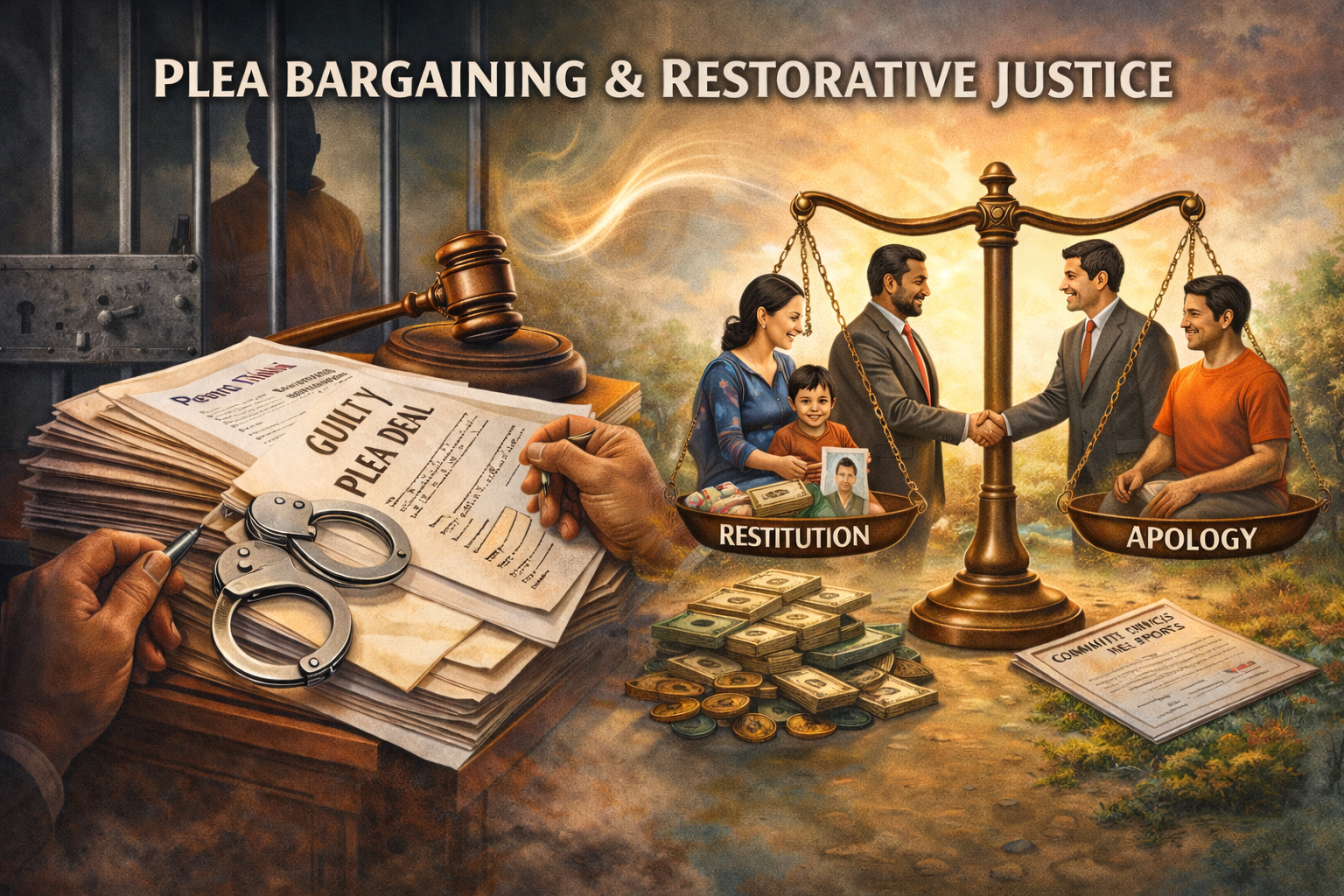
This article examines the convergence between plea bargaining and restorative justice, identifies the structural gaps that limit their synergy, and outlines the reforms necessary to build a more humane and participatory criminal justice system.
Introduction
India’s criminal justice system has traditionally been driven by punishment and deterrence, treating crime primarily as an offence against the State. While this approach may satisfy retributive instincts, it has often failed victims, overcrowded prisons, and delayed justice for years—sometimes decades.
Over the last two decades, however, a quiet but meaningful shift has begun. The introduction of plea bargaining and the growing judicial emphasis on victim compensation, reformation, and rehabilitation signal a movement towards a more humane and participatory justice system—one that closely aligns with the philosophy of restorative justice.
Two major developments highlight this evolution:
- Statutory introduction of Plea Bargaining under the Code of Criminal Procedure (CrPC) in 2005—now continued and refined under the Bharatiya Nagarik Suraksha Sanhita (BNSS), 2023, and
- Growing recognition of Restorative Justice (RJ) as an approach that prioritises healing, accountability, and reintegration.
Understanding Restorative Justice
Restorative justice views crime as harm done to people and relationships, not merely a violation of law. Its focus is on healing the victim, holding the offender meaningfully accountable, and restoring social harmony.
Its core pillars include:
- Healing and empowerment of the victim
- Meaningful acceptance of responsibility by the offender
- Repairing harm and restoring relationships
- Strengthening community equilibrium
RJ may take the form of victim–offender dialogues, restitution circles, conferencing, or community-based reparation. Importantly, its principles can be embedded even within formal statutory procedures—such as plea bargaining.
Evolution of Plea Bargaining in India
Plea bargaining was introduced into India’s criminal process through Chapter XXI-A of the CrPC (2005) with three objectives:
- Tackling judicial pendency
- Reducing delays and trauma faced by victims
- Addressing prison overcrowding
Plea bargaining, now governed by the Bharatiya Nagarik Suraksha Sanhita (BNSS), 2023, allows accused persons facing less serious offences to resolve cases through a mutually satisfactory process involving the victim, the accused, and the court.
Under the BNSS (Sections 289–300), plea bargaining assumes greater procedural clarity and an enhanced emphasis on voluntariness and victim participation. It applies to offences punishable up to seven years, with exclusions for notified socio-economic offences and offences against women and children.
Unlike the prosecutor-driven American model, India’s plea bargaining framework is court-supervised and victim-inclusive, reflecting the core values of restorative justice.
How the Procedure Works
Under the BNSS, plea bargaining follows a clearly defined process. After charges are framed, the accused may apply for plea bargaining within the prescribed time. The court first determines that the request is voluntary and free of coercion. It then facilitates a mutually satisfactory disposition (MSD) between the accused and the victim, where compensation, restitution, or other reparative measures may be agreed upon. Statements made during this process are legally protected and cannot be used for any other purpose. Once an agreement is reached, the court disposes of the case by awarding a reduced sentence or other lawful relief, ensuring both fairness and finality.
Restorative Elements Within Plea Bargaining
Although not expressly defined as a restorative process, Indian PB contains strong restorative components through structured victim participation in the MSD process, which assesses the nature of harm suffered, expectations of compensation, and conditions for reconciliation.
This corrects a traditional imbalance where victims were peripheral to the criminal process.
Reparation and Compensation
The Supreme Court underscored compensation as a core restorative tool, promoting healing and the dignity of victims. MSD outcomes may include direct monetary compensation, restitution of property, undertakings for behavioural reform and community-beneficial actions.
Offender Accountability
Plea bargaining involves the offender voluntarily admitting guilt by participating in a dialogue with the victim and, importantly, by accepting reparative obligations.
These steps align closely with RJ’s focus on responsibility and personal transformation.
Reduction of Adversarial Conflict
Plea bargaining circumvents prolonged trials, diffuses hostility, and accelerates closure for victims. For offenders, it reduces stigma and supports reintegration. This mirrors restorative dialogue—structured, voluntary, and forward-looking.
Why Plea Bargaining Matters for Jail Inmates
For under-trial prisoners lodged in overcrowded jails, plea bargaining offers a humane exit from prolonged and uncertain incarceration. Many inmates remain behind bars for periods longer than the sentences they may ultimately receive, simply because of delays in the trial process. Plea bargaining enables early resolution of such cases, leading to reduced sentences, release on time served, or early reintegration into society. It also reduces psychological distress, preserves family bonds, prevents loss of livelihood, and lowers the risk of hardened criminalisation caused by extended prison exposure. In this sense, plea bargaining serves not merely as a legal remedy but as a corrective against unjust and excessive pre-trial detention.
The Case for a Stronger Probation System
Plea bargaining and restorative justice cannot realise their full reformative potential without a robust and professional probation system. A significant proportion of accused persons coming before criminal courts are first-time offenders who, under existing law, are fully eligible for probation, yet this reformative option remains seriously underutilised. Probation provides courts with a credible alternative to incarceration by enabling supervised release, behavioural monitoring, counselling, and structured social reintegration. Strengthening probation services—through trained probation officers, realistic supervision ratios, individualised rehabilitation plans, and effective coordination with social welfare agencies—can ensure that offenders released through plea-based dispositions remain accountable while being constructively supported. A strong probation framework not only reduces recidivism but also reassures victims and society that justice continues beyond the courtroom and beyond the sentence.
Where Plea Bargaining Falls Short of Full Restorative Justice
Despite overlaps, plea bargaining is not yet a fully restorative process due to limited applicability, restricted to offences punishable up to seven years and exclusion of broad categories such as socio-economic offences and all crimes against women and children. The blanket exclusion of crimes against women and children may unintentionally prolong trauma for victims who seek prompt resolution in less severe cases.
Another bottleneck is the absence of trained restorative facilitators. MSD sessions are usually judge-led and formal.
Restorative dialogue requires facilitators skilled in trauma-informed communication, mediation, empathy-building and conflict resolution.
Yet another shortcoming in the Indian RJ models is the minimal community involvement. Community voices, crucial in many RJ models, have little or no role in the Indian PB structure despite judicial recognition of restorative principles.
To make plea bargaining more meaningfully restorative, institutional support is essential. Legal Services Authorities, mediation centres, counsellors, and trained facilitators can transform MSD from a procedural formality into a genuine healing process.
MSD sessions should incorporate Mediators, Psychologists, Social workers and Restorative practitioners. These professionals can ensure meaningful conversations and balanced outcomes.
All stakeholders—police, prosecutors, defence lawyers, and judges—should be sensitised to the restorative dimensions of plea bargaining.
A Missed Opportunity
Despite its benefits, plea bargaining remains underutilised. Fear of collateral consequences—such as employment barriers, professional disqualifications, or social stigma—often discourages accused persons, even though legal safeguards exist.
Although the statutory framework of plea bargaining clearly stipulates that statements made during the process—particularly the “statement of facts” under Chapter XXIA—cannot be used for any purpose other than determining the voluntariness and terms of the plea, a significant proportion of accused persons still remain apprehensive about its wider consequences.
The fear stems largely from the collateral disqualifications that accompany a conviction—whether reduced or otherwise—such as:
- Ineligibility or barriers to government employment,
- Disqualifications under election laws,
- Professional licensing consequences, and
- Social and economic stigma associated with a criminal conviction.
These anxieties often overshadow the statutory safeguards and procedural fairness built into the plea-bargaining provisions. As a result, many eligible accused refrain from opting for plea bargaining despite its advantages—speedier disposal, reduced sentence, and early reintegration.
To counter this hesitation, there is a pressing need for:
- Systematic awareness programmes for litigants, defence advocates, and legal aid beneficiaries.
- Clear administrative guidance from government bodies regarding the limited collateral impact of convictions arising out of plea-bargained settlements—particularly for minor offences.
- Judicial clarifications and consistent practice directions reinforcing that plea bargaining does not imply guilt beyond the negotiated disposition.
- Training modules for defence lawyers and legal services authorities, so they can confidently advise clients with accurate information.
- Public communication campaigns to reduce stigma and enhance trust in the process.
Greater clarity and outreach can substantially increase the acceptance and utilisation of plea bargaining. Reducing the psychological barrier of “collateral consequences” is as important as the legal framework itself. If apprehensions are addressed, India could witness a significant rise in the number of accused choosing plea bargaining—thereby improving efficiency, reducing pendency, and aligning the criminal justice system more closely with restorative and reformative ideals.
Conclusion
Plea Bargaining marks India’s transition toward a more humane, participatory, and restorative criminal justice system. While initially introduced to reduce caseloads and delays, it inherently incorporates many restorative elements—victim participation, reparative outcomes, offender accountability, and reduced adversarial conflict.
To unlock its full potential, India must consciously integrate restorative philosophy into PB practice: expand its scope, empower victims, strengthen facilitation, and promote reintegration.
Its restricted scope and absence of trained facilitators limit its restorative impact. The legislature may consider allowing PB for additional categories of offences with safeguards, issuing clear notifications regarding socio-economic offences, and revisiting blanket exclusions for crimes against women and children, particularly where victim autonomy and swift relief are paramount.
Plea bargaining should not be viewed merely as a mechanism to reduce pendency or decongest prisons. At its best, it provides timely relief to victims, accountability and reform to offenders, and dignity to families caught in the criminal process.
With thoughtful reforms and institutional support, plea bargaining can become one of the most effective vehicles for restorative justice in India—bridging the gap between law, society, and human dignity. By embedding restorative principles into plea bargaining, India can move closer to a justice system that punishes where necessary—but heals wherever possible.