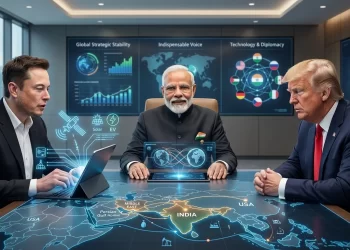


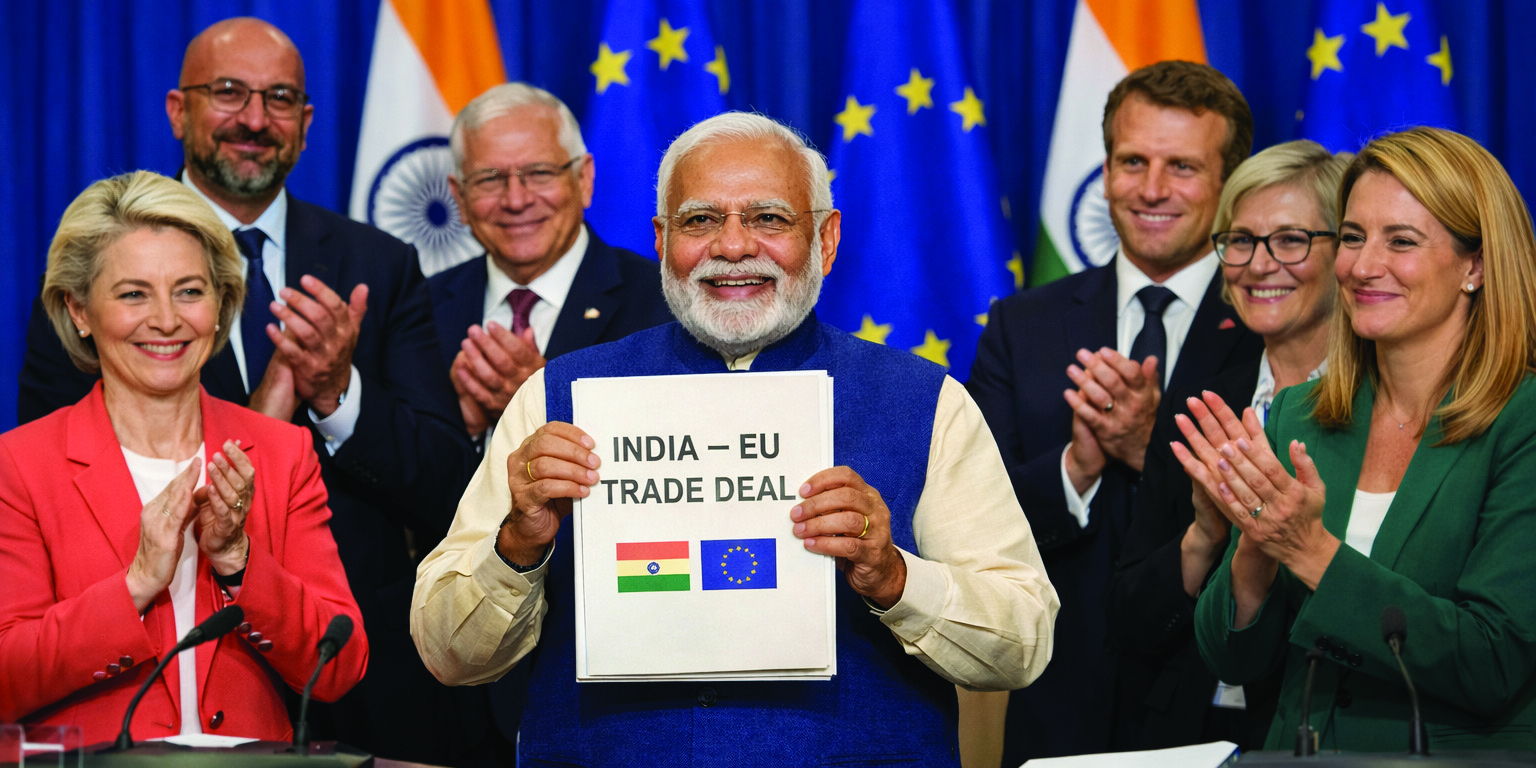
This essay explains the agreement’s terms, its significance for India and the EU, and its benefits for India. It then assesses the deal’s effects on sensitive sectors such as dairy and agriculture, outlines the ratification process and legal steps, examines the agreement’s geopolitical implications, and evaluates the viability of such multilateral agreements amid major power competition.
Introduction
The India–European Union Free Trade Agreement (FTA), concluded on 27 January 2026 after nearly two decades of negotiations, signals a major shift in global trade. Covering nearly one-third of world trade and one-quarter of global GDP, this pact will reshape economic ties between India and the EU’s 27-member bloc. Dubbed the “mother of all deals” for its significance, the FTA is both an economic and a strategic tool for India–EU relations in a volatile world.
“Power and interdependence are inextricably linked.”
— Keohane & Nye, Power and Interdependence
Specifics of the India–EU Free Trade Agreement
Scope and Coverage
The India–EU FTA is comprehensive, covering trade in goods, services, investment, regulatory cooperation, customs procedures, intellectual property rights, and labour mobility. The deal is designed to lower trade barriers and promote two-way flows of goods and services.
Tariff Liberalisation
The EU will eliminate tariffs on 96.6% of its exports to India, saving about €4 billion in duties annually and significantly boosting industries such as automobiles, machinery, wine, and spirits.
India, in turn, will reduce tariffs covering 96.6% of its goods trade with the EU, enabling phased, duty-free or reduced-duty access for Indian exports such as textiles, leather, marine products, chemicals, and gems.
Goods and Services
India will open 92.1% of its tariff lines, covering vast segments over a stage-wise implementation period, potentially spanning five to ten years.
India will open 102 service sub-sectors to the EU, providing predictable market access, especially in sectors such as IT, professional, and digital services, while the EU opens additional areas.
Regulatory Cooperation and Standards
The agreement includes cooperation on Sanitary and Phytosanitary (SPS) measures, Technical Barriers to Trade (TBT), conformity assessment, mutual recognition arrangements, and simplified customs procedures — all aimed at reducing non-tariff barriers and compliance costs.
Investment and IPR Frameworks
The FTA contains provisions on intellectual property rights (IPR) that balance TRIPS-compliant protection with public interest, safeguard India’s generic pharmaceutical industry, recognise traditional knowledge databases, and facilitate cross-border digital trade while respecting data sovereignty.
Importance of the FTA for India and the EU
Economic Significance
India and the EU together account for a substantial share of global trade. Prior to the FTA, bilateral trade in goods and services was estimated at over €180 billion annually, supporting nearly 800,000 jobs in the EU and significant employment in India across export-oriented sectors.
For the EU
Market access to a large and growing consumer base: India, with its 1.45 billion population, presents a dynamic market for industrial and agricultural goods from Europe.
Export growth: European exporters gain improved access to items ranging from machinery and chemicals to avionic parts and automotive products.
Strategic diversification: The EU reduces its reliance on heavy trade with China and the U.S., hedging geopolitical and supply chain risks.
For India
Export competitiveness: Indian labour-intensive sectors such as textiles, apparel, leather, gems & jewellery, and marine products receive significant tariff reExport competitiveness: Indian labour-intensive sectors, such as textiles, apparel, leather, gems & jewellery, and marine products, receive significant tariff relief, thereby enhancing their competitiveness in the EU market.
Investment and technology flows: Reduced barriers attract EU investment into Indian infrastructure, high-technology sectors, and manufacturing, potentially enhancing domestic capabilities.
Benefits to India: Sectoral Gains and Economic Outcomes
Goods Market Access and Competitiveness
- Indian exporters stand to benefit from the reduction or elimination of EU tariffs on key products:
- Textiles and apparel (zero duty on entry), enhancing India’s traditional export prowess.
- The leather and footwear sectors are critical for employment, particularly in smaller cities.
- Pharmaceuticals and chemicals gain through significant tariff elimination, lowering input costs and boosting export potential.
- The liberalisation of tariffs on processed foods and certain industrial items alongside phased duty reductions on automobiles will gradually integrate Indian products into European value chains, thereby expanding export volumes.
Services Sector Enhancement
The FTA’s services component gives Indian firms access to a large, high-margin market. India’s strengths in IT, business services, and consulting are supported by EU commitments to regulatory predictability and national treatment.
Regulatory Modernisation and Standards Compliance
India’s engagement with EU SPS and TBT regulations can spur the adoption of higher standards, improving traceability and food safety—a prerequisite for premium export markets like the EU.
Addressing Concerns in Agriculture and Dairy
Agriculture and related sectors have often been a contentious issue in trade negotiations, especially given India’s large agrarian economy and the socio-political sensitivities surrounding farming.
Protection for Sensitive Sectors
The India–EU FTA excludes sensitive products like dairy, cereals, poultry, soymeal, and certain fruits and vegetables from liberalisation, protecting small farmers from potential import surges.
This “calibrated exclusion” reflects India’s insistence that domestic food security and livelihoods tied to agriculture — which accounts for about 18% of GDP and engages nearly half the workforce — must be protected.
Enhanced Market Access for Export-Oriented Agricultural Goods
While core staples are protected, the agreement provides preferential access for several Indian agri-food exports:
l Tea, coffee, spices and processed foods (zero-duty or reduced duty)
l Fresh fruits and vegetables (grapes, gherkins, dried onions, cucumbers)
l Value-added items like fruit juices and processed meat under specific quotas
These concessions are geared not to domestic price competition but to expanding India’s export footprint in farm-linked products where India has a global comparative advantage.
Safeguards and Non-Tariff Protections
Both sides maintain high SPS standards, with the EU’s stringent regulations ensuring that quality compliance is a market-entry condition, not a basis for arbitrary exclusion.
Despite these protections, some farmer groups in India have expressed concerns. For instance, the Sanyukt Kisan Morcha (SKM) called the agreement “disastrous to farmers”, warning that cheap, subsidised EU agricultural products would enter India and undermine domestic livelihoods and MSMEs.
This highlights the political sensitivity and potential backlash that policymakers must manage as implementation proceeds.
Ratification, Timing, and Legal Approval
Unlike bilateral trade agreements, the India–EU FTA’s legal effect is contingent on ratification by the European Parliament, which must give consent under EU law, and by the national parliaments of some EU member states, where required.
While political support for the deal is strong among key EU leadership — given its potential to diversify trade away from global tensions and protectionist pressures — approval is not guaranteed without debate. The European Parliament can scrutinise issues such as environmental standards, labour rights, and consumer protection. Debate and amendments are possible, but the accession of key EU member states and the political momentum make approval a manageable, though not trivial, process.
Official statements project that the agreement will begin implementation in early 2027, provided all ratifications and legal vetting are completed.
Tariff reductions generally occur on a phased schedule — ranging from immediate duty elimination on certain products to staggered cuts over three, five, seven, or even ten years — to allow domestic industries to adjust.
Geopolitical Significance and Message to the United States
The India–EU Free Trade Agreement sends a clear signal to the United States and other major economies of a multipolar economic order in which large emerging markets like India are not solely reliant on US trade relations. The deal was reached amid rising tariff pressures and protectionist trends in the US, making diversification of trade partnerships a strategic priority.
As Pascal Lamy (Former WTO Director-General) has observed, “the world is moving from multilateralism by default to plurilateralism by necessity.”
By deepening economic ties with the EU, India reinforces its strategic autonomy — balancing relations not just with the US but also with China and other major blocs. The deal also integrates India into European value chains in manufacturing and services, thereby enhancing its position in global trade networks.
The FTA reflects a new form of plurilateralism, in which large trading partners negotiate deep bilateral accords with multilateral effects, countering perceptions of a collapsing global trade system. Yet, this model relies on parallel governance structures and regulatory cooperation, which require sustained diplomatic effort to maintain coherence with global standards.
“Regional trade agreements have become a defining feature of the global trading system.”
— WTO World Trade Report
Deep bilateral or region-to-region agreements can complement the World Trade Organisation’s multilateral system. These plurilateral pathways create high-standard trade rules that can eventually influence broader global frameworks.
Impact on India – USA Trade Deal
The deal sets benchmarks for India’s future trade engagements, including negotiations with the USA, UK, and Canada. It reflects India’s preference for flexibility over rigid, one-size-fits-all trade templates.
The India–EU FTA will influence the trajectory and bargaining dynamics of a proposed India–USA FTA, but it will not automatically lead to such an agreement. The influence will be indirect, strategic, and asymmetric, shaping expectations, leverage, and red lines rather than dictating outcomes.
A preferential trade agreement with the EU may result in the US losing relative market share. EU firms may gain tariff advantages over US firms in India (automotive, machinery, chemicals, services), thereby increasing US corporate pressure on Washington.
By signing trade deals. India is hedging, not aligning. India is a member of the QUAD with the US, trades deeply with the EU, and manages China without economic decoupling, thereby reducing US leverage to use trade as a strategic inducement. The deal signals to the US that India prefers strategic autonomy over bloc-based trade dependence.
The India–EU Free Trade Agreement is unlikely to automatically translate into an India–US FTA, but it fundamentally reshapes the negotiating landscape. For the United States, it creates competitive pressure and strategic incentives, yet also exposes the limits of India’s trade flexibility. Consequently, the EU FTA may nudge India–US trade engagement toward selective, sector-specific arrangements rather than a comprehensive free trade agreement.
Sustainability of Trade Multilateralism and Future Scenarios
The India–EU FTA shows that multilateralism can adapt. However, sustaining such arrangements depends on addressing non-trade concerns, such as environmental standards (e.g., the EU’s carbon border adjustment mechanism), labour rights, and digital data protection frameworks — areas where convergence remains a work in progress.
India’s options in a dynamic global trade environment include deepening trade with emerging markets and regional blocs to diversify risk, negotiating “WTO-plus” agreements on digital trade, e-commerce, and investment facilitation, and using its FTAs as leverage for investment, technology cooperation, and regulatory learning.
These moves ensure that India remains agile and integrated, irrespective of geopolitical realignments.
Conclusion
The India–EU Free Trade Agreement represents a historic shift in global commercial policy, blending economic goals with strategic autonomy in a world rife with geopolitical tensions. By securing broad market access, protecting sensitive domestic sectors, and reinforcing trade cooperation across goods, services, and investment, the deal positions both India and the EU for deeper long-run integration.
While sensitive sectors like dairy and core staples have been safeguarded, calibrated openings in agricultural and value-added exports present opportunities for rural livelihoods and export competitiveness. Ratification will require deliberation in the EU Parliament and domestic processes in India, but the deal’s underlying economic logic and shared interests make approval plausible.
In a global economy shifting away from unilateralism and narrow regionalism, the India–EU FTA exemplifies how well-designed plurilateral agreements can sustain a credible and balanced trade architecture for the 21st century.
Geopolitically, the pact conveys India’s strategic diversification of partnerships, reduces vulnerability to shifting US trade policies, and signals resilience in evolving multilateral trade frameworks. As India’s External Affairs Minister, S Jaishankar states, “India seeks partnerships, not alliances.”