

India’s informal economy, audit institutions and data systems are stronger than the IMF’s ‘C’ suggests, even as methods need updating.
A Harsh Grade for a High-Growth Economy
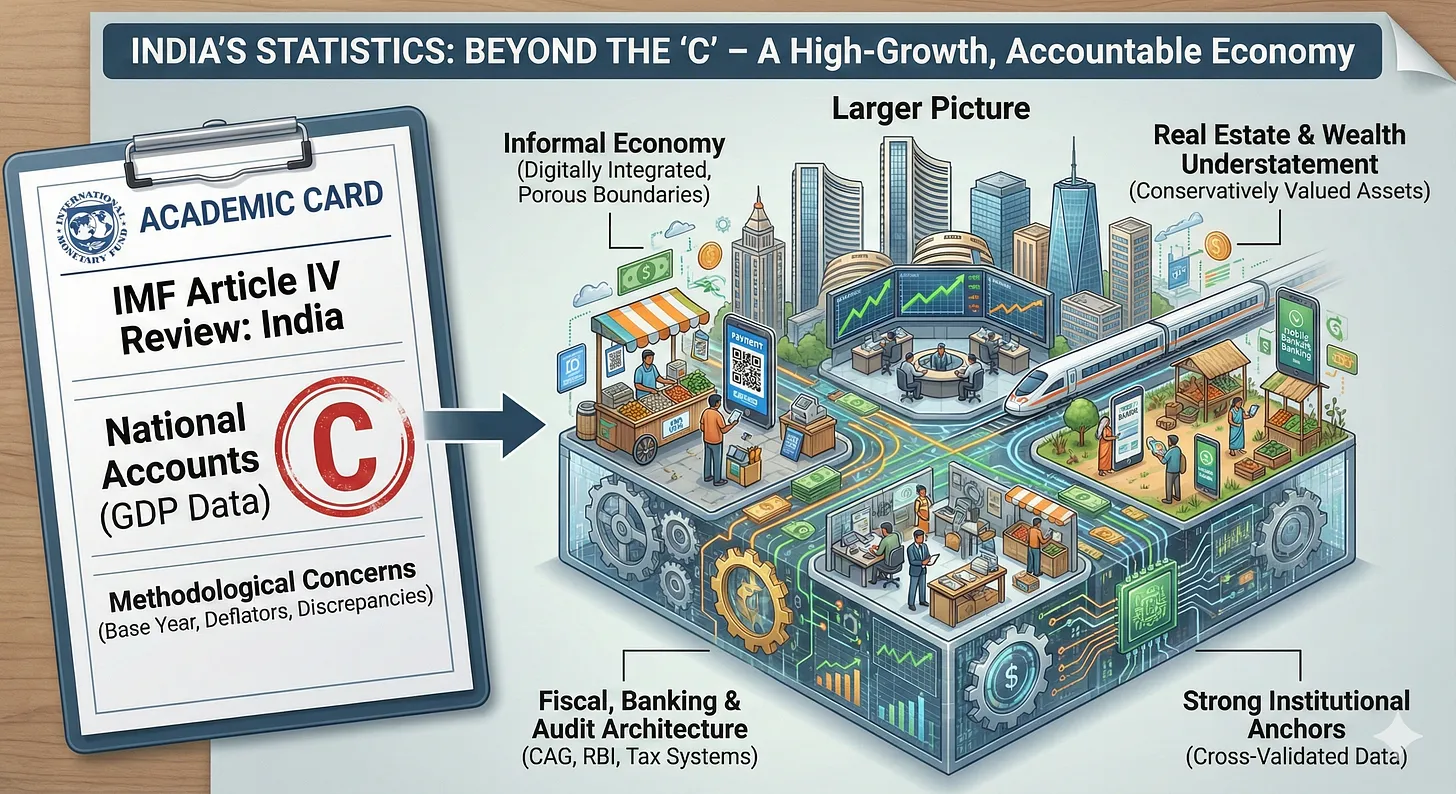
The International Monetary Fund’s latest Article IV review produces an odd juxtaposition. On the one hand, India is routinely described as one of the world’s fastest-growing major economies. On the other hand, the same review assigns India’s national accounts statistics – including GDP and Gross Value Added – a grade of ‘C’, the second-lowest on the Fund’s four-step quality scale. Overall, India’s statistical system is rated ‘B’, but the core macro aggregates are marked as a weak link.
A ‘C’ on national accounts is easily taken to mean that India’s GDP figures are barely adequate for serious analysis. That sits uneasily with the strength and transparency of India’s fiscal, banking and audit architecture, and with the increasingly formal footprint of what is loosely termed the informal economy. Some of the IMF’s technical concerns deserve serious consideration. But the overall judgment fails to capture the way India’s economic reality is embedded in verifiable data systems and institutions.
What the IMF Actually Says
The Fund’s critique is about methodology, not morality. It does not accuse India of fabricating data. Rather, it flags the continued use of 2011–12 as the base year for GDP and the Consumer Price Index, despite significant changes in the economy over the last decade. It notes that, in the absence of a comprehensive system of producer price indices, wholesale price indices still play a significant role in deflating nominal series. It points to “sizeable discrepancies” between GDP estimates obtained from the production or income side and those obtained from the expenditure side, treating these gaps as evidence that household consumption and segments of the informal economy are not fully captured. It also highlights the limited use of seasonal adjustment and the scope for greater disaggregation of quarterly data.
On inflation, the IMF is more generous, awarding India a ‘B’, though it also worries that an outdated base year and basket may no longer reflect actual consumption patterns. Taken together, these points amount to a call for modernisation: more up-to-date base years, better deflators, richer high-frequency techniques and deeper coverage. The puzzle is not that such improvements are sought, but that a system built on strong institutional foundations is placed so low in the IMF’s hierarchy of national accounts.
Reading the Numbers: What New GDP Data Show
The timing of the IMF’s grade is particularly incongruous when set against the latest official GDP figures. In her recent statement on the new estimates, Finance Minister Nirmala Sitharaman noted that real GDP grew by 8.2 per cent in the second quarter of FY 2025–26 (July–September), making India the world’s fastest-growing major economy in that period. For the first half of the financial year, real GDP growth stood at 8 per cent. Far from depicting a muddled or unreliable picture, the national accounts present a consistent view of an economy expanding at a robust pace.
The Finance Minister also underlined that this performance has been driven by sustained fiscal consolidation, targeted public investment and structural reforms aimed at improving productivity and the ease of doing business. High-frequency indicators – from GST collections to power consumption, credit growth and electronic payments – point to continued momentum and broad-based consumption growth. This is not a narrative built on opaque or sporadic numbers. It is grounded in a dense, interlocking web of fiscal, financial and real-sector data that are scrutinised not only by domestic institutions but also by markets, rating agencies and multilateral bodies, including the IMF itself. If those numbers are credible enough to support claims of global growth leadership, the label of ‘C’ on the underlying national accounts begins to look overstated.
A Statistical and Audit Framework with Teeth
India’s public finance and accounting systems are not those of a low-capacity or opaque state where budgets are aspirational, and figures can be dressed up at will. At their heart lies the Comptroller and Auditor General, an independent constitutional authority mandated to audit all receipts and expenditure of the Union and the States. CAG reports are tabled in Parliament and state legislatures and examined by Public Accounts Committees and other standing committees that cut across party lines. The design presumes contestation; fiscal numbers are meant to be challenged and defended in open fora.
Government borrowing is conducted through the Reserve Bank of India within explicit statutory and rule-based limits. Budget documents, RBI publications, and CAG audit reports cross-validate one another. Direct and indirect tax collections are tracked through sophisticated administrative and IT systems, reconciled with treasury accounts and reported in a timely manner. Corporate accounts are subject to statutory audit under company law and, for listed firms, to stringent securities regulations and disclosure norms. In such an environment, the scope for systematically falsifying fiscal or financial data by any meaningful magnitude is minimal. National accounts, however imperfect their methodology, are thus built upon a backbone of verifiable rupee flows.
India’s Informal Economy: Porous, Not Fuzzy
Much of the unease among external observers about India’s macro data stems from a stylised view of the informal economy as a vast statistical blind spot, existing outside the formal system and beyond reliable measurement. This picture is both outdated and misleading. The informal economy is better understood as a space of partially formalised activities, permeated by links to the tax, banking and regulatory systems.
Take the familiar figure of the street vendor. He may not file GST returns in his own name, yet the goods he sells – snacks, garments, household articles – have almost certainly borne GST higher up the supply chain. The wholesaler or distributor from whom he buys is in the tax net. When the vendor uses digital payments for some of his sales, maintains a bank account opened under a financial inclusion scheme, or services a small loan for his cart or vehicle, further slices of his economic life appear in formal datasets. Even where income is under-reported for tax purposes, the spending, saving, and borrowing it finances are often recorded in other forms.
Unreported income is therefore not synonymous with unmeasured activity. Funds that evade direct taxation re-enter the measurable economy through purchases, deposits, loan repayments, school fees, utility bills and asset accumulation. The boundary between formal and informal is porous rather than watertight. The informal sector thus presents a challenge of modelling and attribution, not an impenetrable fog. It is also an economic strength, providing flexibility, self-employment and micro-enterprises that allow the economy to absorb shocks and redeploy labour rapidly.
Banking, Taxation and the Understatement of Wealth
The credibility of India’s macro data ultimately rests on the discipline imposed by financial and tax accounting. Bank deposits, housing loans and other forms of credit are recorded with precision by regulated institutions and monitored by the central bank. Tax authorities maintain detailed records of direct and indirect tax receipts; GST collections, income tax payments and customs duties are regularly reported and reconciled. Auditors, regulators and investors scrutinise corporate financial statements. These interlocking systems impose a hard constraint on how far macro aggregates can drift from underlying reality.
In several respects, official statistics are more likely to understate than overstate private wealth. Real estate illustrates this clearly. In most states, circle rates or guideline values used for registering property transactions are significantly below market prices. Deals typically comprise a declared component at or near the circle rate and a balancing component that may not be fully reported. The recorded value of the housing stock and related tax base is therefore conservative. When homes are financed with formal mortgages, loan values are accurately captured even when the underlying property is worth more than its registered value. The national balance sheet, taken at face value, is almost certainly a lower bound on the accumulated assets of Indian households.
Modernising Methods Without Undermining Confidence
None of this is to suggest that India’s statistical system is beyond reproach. Base years for GDP and CPI plainly need to be updated; producer price indices must be developed more fully; enterprise and household surveys require strengthening; and the broader use of seasonal adjustment and richer disaggregation of quarterly data would aid both policymakers and researchers. The IMF is well within its remit in pressing for such improvements and in benchmarking India against best practice.
Where the Fund’s assessment becomes problematic is in the leap from specific methodological concerns to a blanket ‘C’ on national accounts. That grade implies a level of unreliability that does not sit comfortably with a country whose fiscal numbers are audited and debated to the last rupee, whose banking and tax systems are dense with information, and whose so-called informal economy is deeply entwined with formal circuits of money and data. A more balanced reading would acknowledge that India’s statistics are imperfect and evolving, but fundamentally anchored in accountable institutions and verifiable financial flows.
To miss that anchoring is to miss the larger picture. The task for India is to continue modernising its methods and base years, not to win better marks from external scorecards, but to serve its own policy and democratic needs. The task for its critics, including the IMF, is to recognise that in a complex, partly informal yet increasingly digitised economy, credibility does not rest solely on textbook form, but on the deeper reality that, in the end, the numbers have to add up.
(This article first appeared on the author’s blog, the KBS Chronicle.)