There has been shrill criticism of the NDA government’s diplomatic silence in the present turbulent developments. KBS Sidhu, a regular contributor to SAVIOURS, argues in this piece that India still has a voice that resonates in the corridors of power. The call between Modi and Trump is a quiet reminder that in a turbulent world, New Delhi is now a central, indispensable voice at the global high table.
A Remarkable Call in an Unsettled Moment
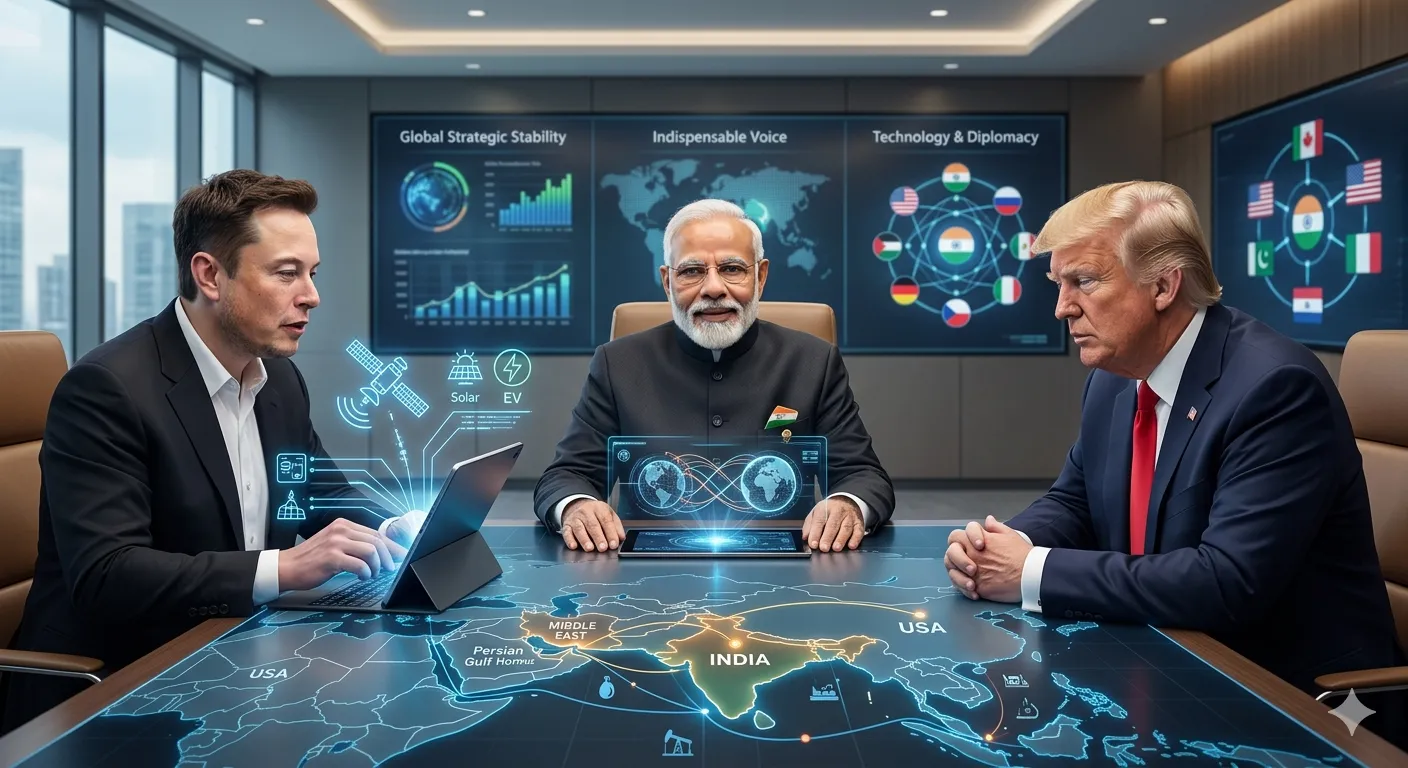
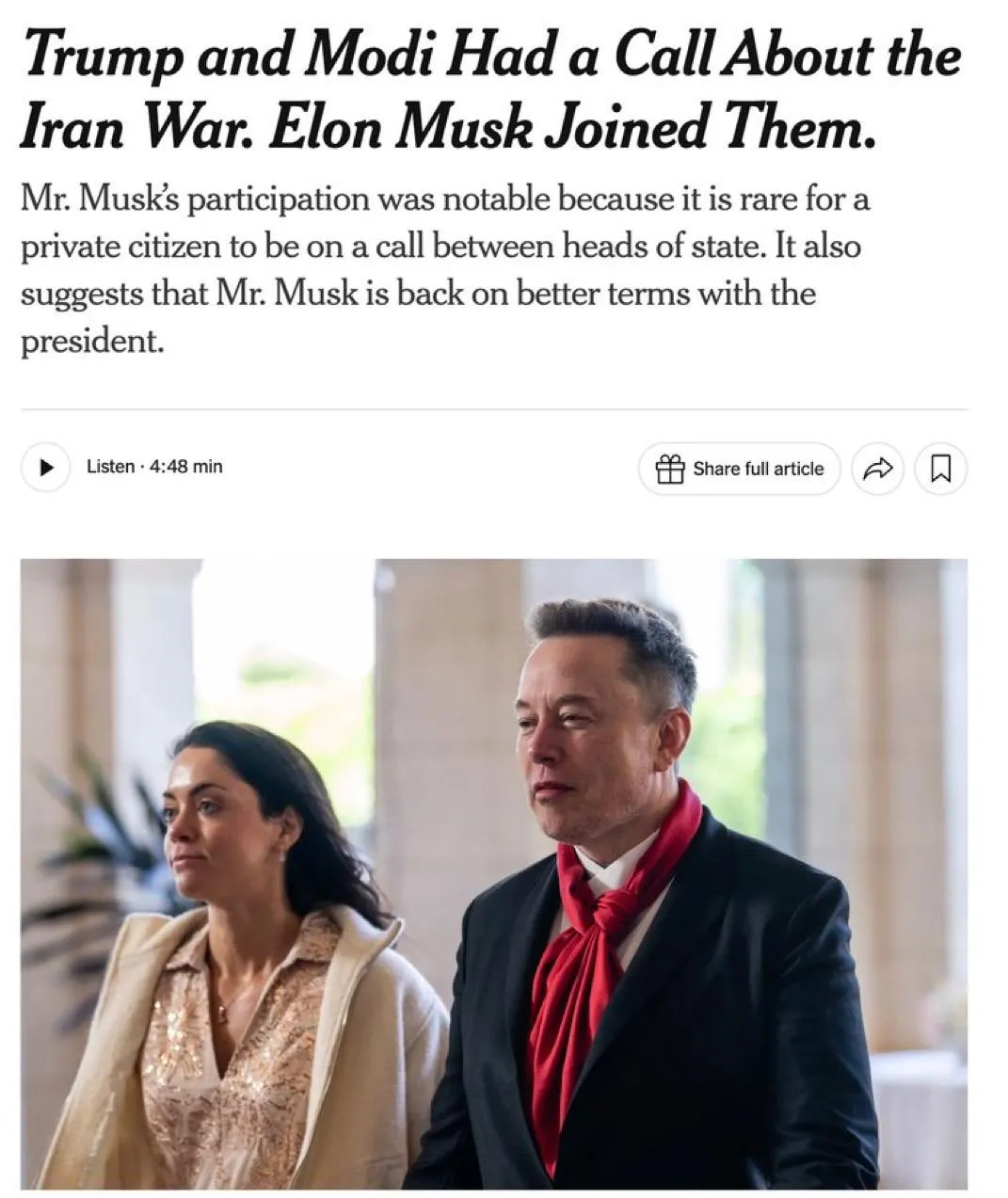
The report in the 27 March edition of The New York Times that Elon Musk joined a recent phone call between President Donald Trump and Prime Minister Narendra Modi to discuss the ongoing Iran conflict and its impact on energy markets is striking on several counts. It is highly unusual for a private entrepreneur to be present during a conversation between two heads of government at a time of war. Even more noteworthy is the fact that one of those leaders is India’s prime minister, whose participation in such a high-level exchange now appears almost taken for granted.
Just a decade or two ago, India was rarely at the centre of urgent global consultations on security and energy. Today, New Delhi is no longer a peripheral voice but an essential participant whenever great powers discuss war, peace, and the future of critical supply chains. The Trump–Modi–Musk call is less about the personality of a billionaire and more about the structural reality of India’s rise.
That reality becomes even more striking when viewed against the immediate diplomatic backdrop. Prime Minister Modi had visited Israel only a few days before the hostilities broke out, yet India has not allowed visible proximity to one regional power to rupture its working relationship with another. New Delhi has sought, with considerable care, to preserve good relations with Iran even while deepening ties with Israel, the Arab Gulf states and the United States. This is not diplomatic ambiguity. It is a calculated effort to retain access, communication and influence across fault lines that have become sharper and more dangerous.
India’s Energy Stakes and Strategic Geography
India’s interest in any conflict involving Iran is direct and substantial. As one of the world’s largest importers of crude oil, India remains deeply exposed to volatility in the Gulf and, in particular, to disruptions in the Strait of Hormuz. Even modest disturbances there can ripple through to pump prices in Chandigarh or Chennai, complicating both macroeconomic management and household budgets.
That concern is not merely abstract. India’s vulnerability is magnified by the exposure of Indian ships and India-linked cargoes moving through the region. If the Strait of Hormuz becomes insecure, it is not only energy prices that are affected, but also the safety of commercial shipping, seafarers and supply chains on which India depends. Reports that Iranian authorities have continued to permit safe passage to Indian-flagged vessels or to ships seen as connected to friendly countries only reinforce the point that India cannot afford the luxury of severed communication with Tehran. In moments of crisis, practical relationships matter more than rhetorical postures.
New Delhi, therefore, has every reason to be at the table when Washington and others discuss escalation, de-escalation, or sanctions that might choke off energy flows. At the same time, India has long-standing civilisational, economic and diaspora ties across West Asia. It has deliberately cultivated balanced relationships with Iran, the Arab Gulf states, Israel and the United States—an approach that may look cautious to some, but which has insulated India from being boxed into another’s camp.
In this context, Modi’s participation in a high-level call on the war in Iran is not a favour bestowed by Washington; it is recognition that without India’s cooperation and perspective, any effort to stabilise energy markets or manage regional fallout will be incomplete.
Screenshot from The New York Times, 27th March 2026 edition.
The Musk Factor: Business, Technology and the New Diplomacy
Elon Musk’s presence on the call has inevitably attracted outsized attention. It underlines how much cutting-edge technology and global capital have become entwined with statecraft. Space launches, satellite constellations, electric vehicles, battery supply chains, and social media platforms all intersect with strategic power and information flows.
For India, interlocutors like Musk represent both an opportunity and a test. On the one hand, his companies sit at the frontier of several sectors that matter deeply for India’s development—electric mobility, renewable energy storage, satellite-based internet, and advanced manufacturing. On the other hand, such actors are not neutral utilities; they come with their own geopolitical entanglements, investor pressures and political preferences.
A mature Indian approach would welcome investment and innovation while insisting that decisions affecting our digital space, infrastructure and public discourse respect Indian law and Indian interests. Participation in high-level calls should not translate into private vetoes over public policy. New Delhi’s challenge is to use such engagement to deepen technology partnerships on terms that enhance, rather than dilute, strategic autonomy.
Strategic Autonomy in a Polarised Conflict
The Iran war, and the surrounding debate about who “started” it, have quickly become polarising issues in Western discourse. For India, however, the priority is less about assigning moral blame and more about preventing a dangerous regional spiral that would hit our economy and our diaspora.
This does not mean moral relativism. India has consistently called for restraint, protection of civilians and respect for international law, whether in West Asia, Ukraine or elsewhere. But New Delhi has also resisted the temptation to collapse complex conflicts into binary narratives of “with us or against us”. That posture has sometimes invited criticism, particularly from Western commentators who expect automatic alignment with their preferred side.
Yet it is precisely this even-handedness that gives India credibility across divides. Iran, the Arab states, Israel, the United States, Russia and Europe all find in India a country that may not please everyone all the time, but that rarely closes doors or burns bridges. A pro-India stance, in this sense, is not about loud declarations; it is about quietly preserving space for dialogue when others are talking only of punishment or victory.
There is, in this setting, a revealing contrast with the attempt in some quarters to present Pakistan as a broker of peace or a serious mediator in the crisis. That may be an inflated description of what is, at best, a narrower and more functional role. A conduit, or even a messenger, can sometimes be useful in tense situations, but such a function should not be confused with strategic centrality. India is not merely passing messages between estranged powers. It is part of the substantive conversation because its interests, capabilities, and consequences are too significant to ignore.
India’s Emerging Role as a System-Stabiliser
The call featuring Trump, Modi and Musk also highlights how India is increasingly viewed as a system-stabilising power. As supply chains reconfigure, cyber and space domains become contested, and great-power rivalry intensifies, there is a premium on players who can manage contradictions rather than magnify them.
India’s size, demography and market potential give it leverage. But what makes that leverage valuable is the country’s demonstrated ability to engage with multiple camps—Quad and BRICS, I2U2 and INSTC, Washington and Moscow, Jerusalem and Tehran—without collapsing into dependency or vassalage. In the energy arena, India has diversified suppliers, invested in strategic reserves, and bargained hard on price and terms, even when that has annoyed partners.
A phone conversation about the Iran war that must factor in Indian concerns on energy security, shipping lanes, maritime passage and expatriate safety is a sign that others recognise this stabilising role. India is not a passive recipient of outcomes decided elsewhere; it is an active shaper of those outcomes, albeit often through quiet diplomacy rather than megaphone theatrics.
Looking Ahead: Partnership Without Illusions
For India, the way forward lies in deepening ties with both the United States and key regional actors, while maintaining sufficient independence to say “no” where our interests or values demand it. Engagement with global business leaders—from Musk to lesser-known executives—should be conducted with clarity and confidence.
New Delhi can and should encourage investments in clean energy, advanced manufacturing and digital infrastructure. At the same time, it must continue to insist that platforms operating in India respect our democratic processes, regulatory frameworks, and social fabric. Strategic partnerships flourish when all sides understand that sovereignty is not up for bidding, even in an era of private rockets and cross-border data flows.
In that sense, the Trump–Modi–Musk call is a snapshot of the emerging international order. States remain the primary actors, but they now share the stage with powerful private entities whose decisions shape war, peace and prosperity. For India, the task is not to shut these players out, nor to surrender to them, but to integrate them into a foreign policy anchored in national interest and civilisational self-confidence.
A Quiet Confidence, Not Chest-Thumping
There will be those who read the episode primarily through a partisan lens: as proof of American overreach, of Indian subservience, or of billionaire influence. A more balanced view sees it as confirmation that India has arrived at a point where its voice is both sought and needed in crises far from its shores.
Pro-India does not have to mean triumphalist or uncritical. It can mean a calm recognition that the country has hard-won agency, that this agency should be exercised with prudence and dignity, and that India’s leaders—whichever party is in power—have a responsibility to protect national interests without being swept up in others’ conflicts.
The real story in this phone call is not the novelty of Musk’s presence, but the normality of Modi’s. India, at the centre of global deliberations, is no longer an aspiration; it is becoming the default setting of a changing world.
(The article first appeared on the author’s blog KBS Chronicles.)
KBS Sidhu, is a former Special Chief Secretary of Punjab. He is an MA in Economics from the Manchaster University.
He writes of geopolitics, economy, terrorism, human rights, South Asian geo-stability and the intersection of trade policy and Trump-era tariff tactics.