
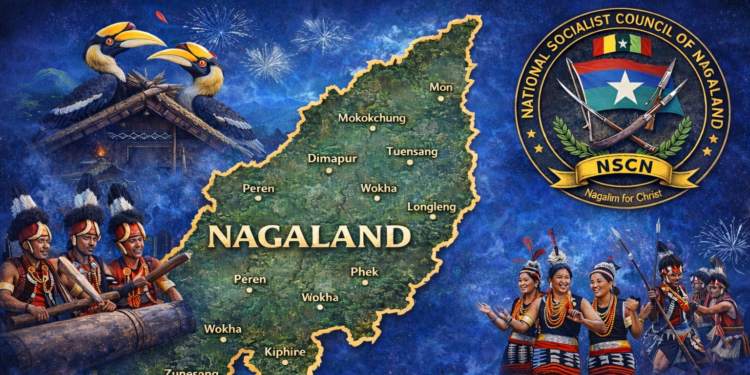
Sharda Prasad, a seasoned expert on the Northeast, shares a first-person account of the Nagq problem as he sees it. He provides suggestions at the end of his piece for resolving the long-pending issues.
Introduction
In 1975, I worked in the interiors of North Cachar Hills (now Dima Hasao) in Assam, near the Assam-Manipur border. The area was home to several communities, including Dimasa Cachari, Hmar, and Zemi Naga. During a visit to Hangrum, a Zemi Naga village, I witnessed young Nagas bringing in a deer that had been captured and killed in my honour at the headman’s request. The boys had chased the deer through dense jungle until it collapsed from exhaustion, demonstrating remarkable stamina and determination. This resilience and persistence are characteristic of Naga communities and should be taken into account when discussing Naga issues.
Two years later, I was assigned to the Dhansiri River along the Assam-Nagaland border, where I was responsible for border security and railway protection. The patrol path was narrow and surrounded by dense vegetation. Encounters with wildlife or Naga insurgents, known locally as the ‘junglee party,’ were common. An unspoken understanding prevailed: as long as neither side interfered, peace was maintained. Today, Naga insurgents continue to promote this approach, treating the area as if it were governed by two sovereign entities—the ‘Government of India’ and the ‘Government of Greater Nagalim’—both of which advocate peaceful coexistence. This duality remains central to the ongoing issues.
Historically, the Naga Club (1918) petitioned the Simon Commission in 1929, stating, ‘Let Nagas be left alone to decide for themselves.’ As the British departed, the Naga National Council, led by Angami Zapu Phizo, declared independence for the Naga territories on 14 August 1947, one day before India’s independence. The call for self-determination persists. Plebiscites organised by the Forum for Naga Reconciliation, notably on 16 May and in 1951, aimed to assert Naga independence. Naga insurgent intellectuals argue: “You (Indians) were fully slaves of the British. We were not even half slaves. When the British left, you became independent, and we did too. That doesn’t give you the right to treat us as your slaves.” This belief in self-determination remains deeply rooted.
Who is a Naga
Defining who is a Naga is complex, both socially and anthropologically. There are about 20 main groups and 100 subgroups, including Ao, Angami, Chakhesang, Konyak, Lotha, Rengma, Sumi, Tangkhul, and Zeme, each with distinct cultures, languages, and traditions. There is no common Naga language; Nagaland has adopted English as the official language and Nagamese for local communication. Although approximately 89 per cent of Nagas are Christian, there are many denominations, and churches are highly compartmentalised. Churches offer significant grants and scholarships, leading to intense competition for new members, sometimes even within families. Despite these divisions, the Church remains a unifying and guiding force in the Naga community.
It is important to note that ‘Greater Nagalim’ is envisioned as a Christian state rather than a secular entity. This vision conflicts with the foundational principles of Indian polity.
Territorial claims for ‘Greater Nagalim’ are also contentious. The NSCN-IM asserts that all areas inhabited by Nagas, including parts of Arunachal Pradesh, Assam, and Manipur, should be merged with Nagaland. These states have objected to such proposals. Additionally, the NSCN-IM seeks to include territory adjacent to Myanmar, which lies beyond the Indian Government’s jurisdiction.
Ground Reality
Recently, during Thuingaleng Muivah’s (General Secretary of the NSCN-IM) visit to his village, Somdal, in the Ukhrul district of Manipur, he blamed the Government of India for the stalemate in the Peace Talks. He discussed the possibility of the Nagas returning to the battlefield to achieve their objectives. Even the ‘ Commander in Chief ‘ of NSCN IM, Lt Gen Anthony Ningkham Shimray, has confidently spoken ( at their Camp Hebron) about taking to Arms. Apparently, the Naga underground Army pays its cadres well, and that’s how its cadres have swelled. However, many of the seniors have by now invested heavily in business and Commercial concerns in Nagaland and other areas, including abroad. Any deviation from the present position of the Truce will hit the Naga ‘movement ‘ in two disastrous ways.
Firstly, it will affect their earnings today through legitimate business activities such as tourism, Real Estate, and factories.
Secondly, once peace is disturbed, the Indian Army could intervene on the pretext of containing disturbances, thereby disrupting their Extortion (in the name of Tax collection) racket, leading to a severe decline in revenues for their ‘Government’.
The renewed insurgency could also hit NSCN IM’s trade in Narcotic Drugs across the border. It will also expose fissures within the insurgent groups and might reignite the leadership issue, given T Muivah’s advanced age. The Naga’ movement’ has a long history of splits, and that history may repeat itself. All told, the threat to peace due to the Nagas taking to violence again cannot be ignored. Any misstep in that direction will negate the gains achieved so far through a series of painstaking negotiations.
Way forward
The Naga Problem has remained unresolved for more than seven decades. However, the notion that postponing a decision is also a decision may not be advisable in this case. One can draw lessons from Assam about how the ULFA was rendered irrelevant to day-to-day functioning and unattractive as a source of employment. Over the decades of struggle, the ULFA has already lost its appeal to the new generation. The handling of MNF in Mizoram also has many lessons for us. Half-baked publicity-oriented recipes such as the Shillong Peace Accord (1975) or the Framework Agreement (2015) are not helpful.
Thankfully, some Naga groups do not still believe in taking up arms. We need to encourage them to reach a peaceful solution acceptable to all parties.
The myth that the Nagas are outside this great Nation must be actively countered through multiple methods at all available fora. We must encourage the generation born after 1950 to articulate their aspirations and propose acceptable solutions. This is the generation that has benefited from the Provisions of the Indian Constitution, has faith in the democratic and secular form of the government, has participated in the Indian democratic process, and has appreciated being part of this great Nation. It is encouraging that during the 2014 General Elections, Nagaland recorded the highest voter turnout (87 per cent) in the country.
The church has a significant persuasive role in the Naga community. For a Christian Naga, Christ is concerned with their well-being and loves them.
While India is a secular nation, religion remains significant. The Church, as a moral guide in Naga society, can play a constructive role in promoting social integration. Since NSCN-IM envisions Greater Nagalim as a land for Christ, the Church’s influence is substantial. Ensuring peace in the Northeast also aligns with the Church’s interests.