“The greatest threat to a nation is not external aggression alone, but internal weakness.”
— K. Subrahmanyam, Strategic Affairs Expert
Introduction
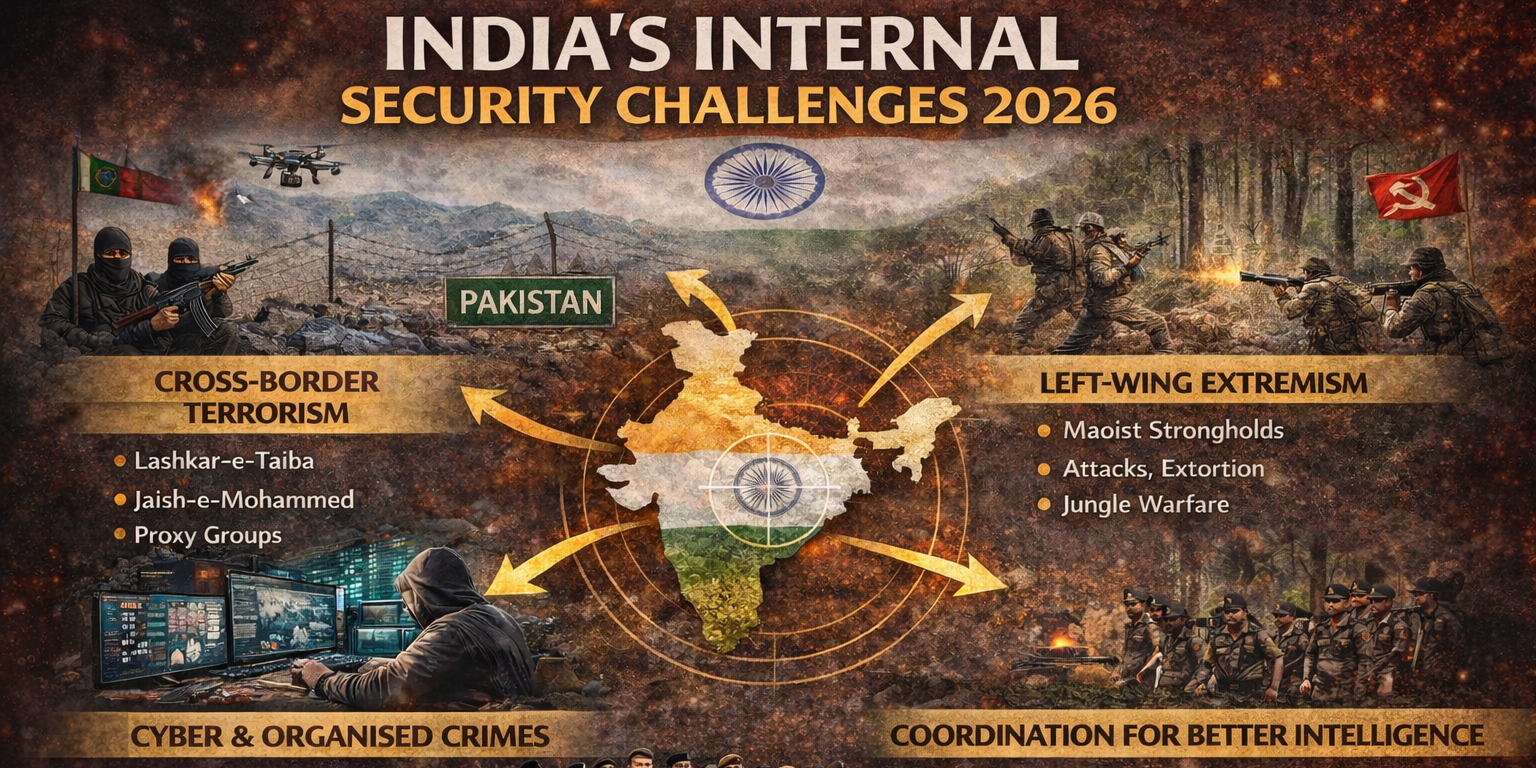
Internal security constitutes one of the most vital pillars of India’s national security architecture. By 2026, threats have evolved from conventional insurgency and terrorism to a more complex, technology-driven environment. Traditional risks like terrorism in Jammu and Kashmir, Left-Wing Extremism (LWE), and organised crime persist. At the same time, emerging challenges such as cybercrime, information warfare, AI-enabled disinformation, and social polarisation have introduced new complexities.
These challenges are compounded by economic and political instability in India’s immediate neighbourhood, which is affecting border management and geopolitics across South Asia.
Internal security challenges now extend beyond physical violence or territorial control to include non-contact warfare, psychological manipulation, digital infiltration, and economic disruption. The distinction between internal and external security is diminishing as hostile actors exploit India’s vulnerabilities through cyber tools, proxy groups, and information campaigns. In 2026, internal security will require safeguarding democratic institutions, social cohesion, and economic stability, rather than merely maintaining law and order.
This essay reviews the primary internal security challenges India may face in 2026, supported by recent data, identified terror groups, operational trends, and institutional responses. It also assesses the effectiveness of India’s counter-security strategies.
Terrorism: Persistence, Radicalisation, Transformation and Hybrid Threats
Pakistan-sponsored terrorism remains India’s most persistent internal security threat. Terrorist organisations such as Lashkar-e-Taiba (LeT), Jaish-e-Mohammed (JeM), Hizbul Mujahideen, and their proxy front, The Resistance Front (TRF), continue to target Indian security forces and civilians, particularly in Jammu and Kashmir. The emergence of TRF enables Pakistan to maintain plausible deniability while continuing cross-border terrorism.
Since the abrogation of Article 370 in 2019, large-scale terror incidents have declined, but terror networks remain. Terrorist groups have shifted from mass attacks to targeted killings of minorities and political workers, attacks on non-local labourers, and the use of small, mobile terror cells. Major metropolitan cities remain vulnerable due to their dense populations, symbolic value, and high concentration of soft targets.
In 2026, terrorism in Kashmir is expected to remain low-intensity yet persistent, aiming to destabilise governance.
Although India has not witnessed large-scale ISIS attacks, ideological influence from ISIS (Islamic State), ISIS-Khorasan (ISIS-K), and Al-Qaeda in the Indian Subcontinent (AQIS) remains a concern. Several ISIS-inspired modules have been busted in Kerala, Karnataka, Tamil Nadu, Maharashtra, Uttar Pradesh, and Telangana.
Indian agencies have pre-empted several attacks, but threats persist due to online propaganda, deepfakes, AI-generated content, and the radicalisation of isolated individuals.
Technology-enabled terrorism and radicalisation present a critical challenge. This is evident in the recent case of “white collar terrorism” involving skilled medical professionals from Jammu & Kashmir, operating from institutions such as Al Fatah University in Haryana. Terror groups increasingly use encrypted platforms, social media, and artificial intelligence for recruitment, propaganda, and financing.
The rise of lone-wolf attacks and decentralised modules, financed and coordinated by handlers in Pakistan or other countries, complicates detection, especially in urban areas. In regions like Jammu & Kashmir, cross-border support and radicalisation remain significant concerns.
Geopolitical dynamics in neighbouring countries make several Indian states vulnerable to direct and online radicalisation, often with the tacit support of foreign law enforcement and intelligence agencies. In this context, the northeastern states may increasingly become vulnerable.
In 2026, the primary challenge is the unpredictability of attacks, making prevention and intelligence gathering crucial.
Left-Wing Extremism (LWE): Decline, Data and Residual Risks
Left-Wing Extremism, led by the Communist Party of India (Maoist) and its armed wing, the People’s Liberation Guerrilla Army (PLGA), has declined significantly over the past decade. The Government has publicly set an ambitious target of March 31, 2026, for the eradication of Naxalism.
Government and security data show violent incidents declined by nearly 53% between 2014 and 2024. LWE-affected districts dropped from 182 in 2013 to about 18 by 2025, and civilian fatalities fell by over 26% in recent years. In 2025, over 300 Maoists were killed and nearly 400 arrested across several states, while thousands surrendered under state rehabilitation policies. State governments in Chhattisgarh and Odisha made significant gains in weakening the LWE operational capacity.
This decline reflects sustained security operations, better intelligence coordination, and development-focused initiatives.
However, a large cache of government arms looted at the height of the LWE remains unrecovered. The MHA and state governments must reconcile missing inventory with recovered weapons. Improvised explosive devices stay on roads and tracks near LWE strongholds. Surrenders should be accepted only when service weapons and information about buried IEDs are provided. Until all the looted weapons are recovered and IEDs rendered safe, it would be incorrect to accept defanging of LWE cadres as complete, and it would be viewed as a tactical retreat rather than defeat.
Urban Maoist support networks, which provide ideological, legal, and logistical support, remain a concern.
There is a saying: “Insurgency cannot be defeated by force alone; governance is the ultimate counter-insurgency.” Despite operational success, structural vulnerabilities persist, including tribal alienation, land disputes, mining-induced displacement, governance deficit in remote areas, and climate-related stress on forest-based livelihoods. These vulnerabilities could lead to a resurgence if development efforts stall. This highlights the need for a balanced approach that combines security measures with inclusive growth, as outlined in thGovernment’s’s SAMADHAN scheme.
Cybercrime and Cybersecurity: India’s Fastest-Growing Internal Security Threat
“Future wars will be fought not on borders, but on servers and screens.”
Cybercrime is now the fastest-growing internal security challenge for India and its law enforcement agencies.
In 2024, India reported cyber fraud losses of approximately ₹22,846 crore, a 206% increase over 2023. Cybercrime complaints increased by more than 400% between 2021 and 2024. High-value cyber fraud cases increased from 6,699 in FY 2022–23 to over 29,000 in FY 2023–24. Financial institutions, such as the State Bank of India (SBI), recorded 15,956 cases between January 2024 and October 2025, resulting in significant losses. The growing scale and sophistication of scams show that cybercrime targets both individuals and institutions. This rapid growth highlights the vulnerability of India’s digital ecosystem.
Cybercrime in India includes phishing, financial fraud, fake investment and job scams, ransomware attacks, deepfake-based extortion, identity theft, and data breaches. Digital arrests by impersonating government authorities are now common. The use of deepfakes and disinformation to inflame communal tensions, polarisation, undermine political leadership, or influence elections threatens democratic stability.
Semi-urban and rural areas have become major hotspots, showing that cybercrime is no longer an urban phenomenon.
It may not be long before India faces the risk of cyberattacks on Power grids, Railways and metro systems, Airports, Banking and payment systems, and Defence networks. State-sponsored cyber actors, especially from China and Pakistan, are suspected of probing Indian infrastructure, highlighting the convergence of cyber and national security threats.
In 2026, India should focus on building cyber resilience and investing in skilled manpower and legal frameworks to address rapidly evolving threats. Countering disinformation while protecting freedom of speech will be a major challenge in the coming year.
Communal Polarisation and Social Unrest
Communal and identity-based tensions remain a serious internal security challenge. Triggers include social media rumours, politically charged narratives, international events with domestic impact, and sensitive judicial or policy decisions. Rapid crowd mobilisation via digital media has complicated law-and-order management. Community leaders and the media have a greater responsibility to prevent isolated incidents from spiralling into a generalised sense of persecution.
Elections are known to increase hate speech globally. India is no exception. The only difference is that elections in India are a year-round tamasha. All political parties at the national and regional levels must exercise restraint in vilifying a religion, sect, community or region. In fact, they should work towards creating a national identity, shedding their parochial identities.
Border–Internal Security Nexus and Narco-Terrorism
The India-Bangladesh, Pakistan, and Myanmar borders will continue to require greater vigilance in 2026 as well. Drone-based smuggling in Punjab and Jammu, especially using Chinese-made drones from across the border to smuggle arms, ammunition, and narcotics, poses a serious threat. While detection and neutralisation have improved, undetected drones may still outnumber those intercepted. The newfound strategic bonhomie between Bangladesh, Pakistan, and China may make our largest land border in the east more sensitive and vulnerable.
Drug trafficking from multiple borders can destabilise Indian society and generate enough funds for the narco terrorism to finance terror outfits to bleed India with a thousand cuts.
Infiltration and Proxy Warfare
Infiltration attempts across the LoC continue during periods of geopolitical tension, reinforcing the linkage between external threats and internal secur ty. Such infiltration poses several security risks, including demographic imbalances in border regions. Border management, therefore, must be closely linked to internal policing and intelligence.
The whole business of intelligence gathering and processing begs for doctrinal change, from secretive intelligence operations to public intelligence characterised by cognitive alignment between society and the executive.
Northeast Needs Attention
As noted above, the new geopolitical convergence among Bangladesh, Pakistan, and China may destabilise the northeastern states of India. Turning a blind eye to insurgent camps for harbour and training in Bangladesh could reverse the peace in some of the states.
Manipur’s situation needs immediate resolution. The state has been in the throes of ethnic strife for too long.
Organised Crime and Economic Security
Organised crime networks are involved in hawala, money laundering, extortion, contract killings, illegal betting, and human trafficking. The use of cryptocurrencies and shell companies for their financial transactions complicates enforcement. Unfortunately, these networks have been increasingly intersecting with terror financing and political corruption.
Institutional and Structural Challenges and Reforms
Manpower shortages, training gaps in cyber and forensic domains, and outdated equipment are major challenges for the civil Police. Police reforms remain largely theoretical, with little visible change in procedures or attitudes.
For India to aspire to be Viksit by 2047, there is an urgent need to free local law enforcement agencies from unwarranted executive and bureaucratic control by providing greater autonomy, financial independence, and operational space. Ordinary citizens, not the rich and powerful, should be the focus of law enforcement agencies. The new criminal laws are a step in that direction. The civil Police across the country need to earn the trust of the people they are sworn to serve.
Similarly, judicial reforms are a pressing need. Delayed justice undermines litigants’ trust in the judiciary and reduces GDP by nearly three percentage points. More courts and correctional facilities should be created without any further delay.
Centre–State Coordination
Internal security is a state subject, but threats are transnational. Effective, real-time coordination among state Police, NIA, IB, CAPFs, local administration, border forces, and intelligence agencies is essential. Significant progress has been made in this field, but these gains must be further consolidated.
Conclusion
India’s internal security challenges in 2026 are multi-dimensional, technology-driven, and deeply interconnected. While terrorism and Left-Wing Extremism have been contained, cybercrime, information warfare, and social polarisation present newer and potentially more destabilising threats. The focus has shifted from visible enemies to invisible threats, such as algorithms and narratives, which pose deeper systemic risks.
The true test of internal security is not only neutralising armed threats but also strengthening institutions, governance, and social cohesion. Intelligence-led policing, cyber resilience, inclusive development, and democratic accountability must work in tandem.
Ultimately, India’s success in safeguarding internal security in 2026 will depend on its ability to adapt faster than its adversaries, while remaining anchored in constitutional values and democratic principles.
“Inter al security is not merely the absence of violence, but the presence of trust.”