
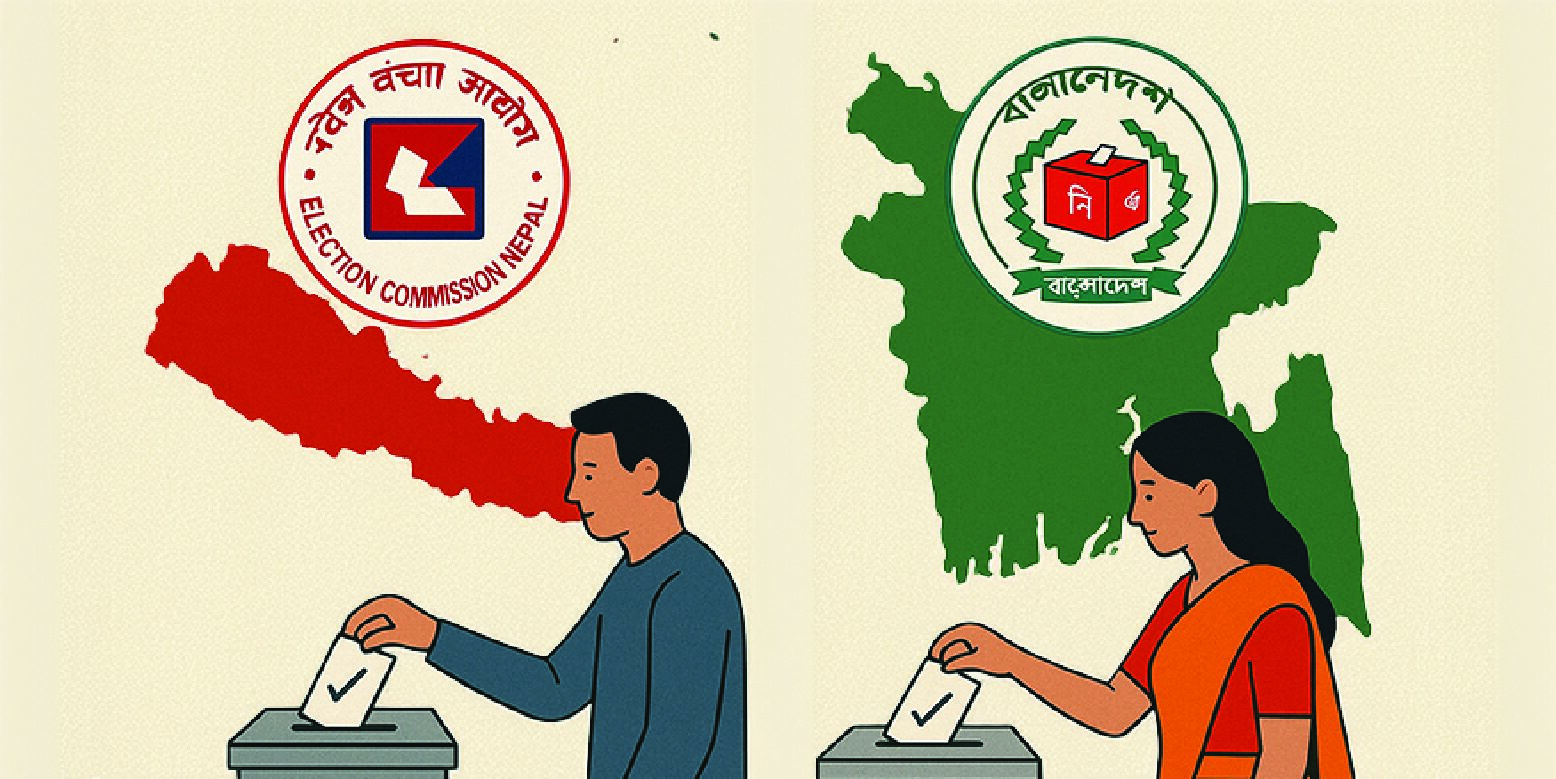
Elections in Nepal and Bangladesh in the coming months are of immense interest to India as they may reshape the geopolitics of South Asia and impact our Neighbourhood First Policy
Introduction
Since the last decade, many South Asian countries have been optimistic that their demographic dividend would boost economic growth, resulting in better job opportunities, compared to the ageing population in developed countries, including China, where productivity was expected to dip.
This came to nought when job creation in these countries failed to meet expectations, sparking an explosion of youth anger and leading to drastic changes in government in Sri Lanka (2022), Bangladesh (2024) and Nepal (2025).
While Sri Lanka has become moderately stabilised after its 2024 elections, it remains to be seen how far Bangladesh and Nepal will balance out after their elections in February and March 2026, respectively.
Bangladesh
As Bangladesh heads toward its February 12, 2026, elections, indicators to assess public preferences are puzzling. The controversial 7 January 2024 elections were considered rigged after the Awami League (AL), led by Sheikh Hasina, triumphed with 271 seats. Jatiya Party (Ershad) followed AL at a distance with 13 seats. The remaining seats were won by four minor parties, each with one seat, while independents, mostly AL followers, secured 62.
The Bangladesh National Party (BNP), led by the ailing Khalida Zia and her son Tarique Rahman, boycotted the election after the AL rejected their demands for an independent caretaker government to conduct the polls.
The “Gen Z agitation” that rocked the country began peacefully in July 2024. It had arisen from deep frustration among the youth that the country’s much-advertised GDP growth had not translated into more jobs. The main grievance was against the scheme of reservation of 1/3rd civil service jobs to the families of those who participated in the 1971 Independence War, which went mainly to AL cadre families.
Sporadic violence during these demonstrations went out of control when massive force was used to crush the protests, resulting in 300 deaths. This situation enabled the pro-Pakistan and fundamentalist lobbies to take advantage of the situation, alleging that Sheikh Hasina was India’s puppet. As a result, Hasina was forced to flee on 5 August 2024. An Interim Government (IG) under Dr Muhammad Yunus assumed power on 8 August 2024.
On 10 May 2025, the IG banned AL under the Anti-terrorism Act. On 17 November 2025, the International Crimes Tribunal (Bangladesh), created in 2009 for prosecuting the 1971 war crimes, sentenced Sheikh Hasina to death for alleged crimes against humanity.
Consequently, the proposed February elections would be a contest between the parties that signed the “July National Charter” on 17 October 2025. The main parties are the Bangla Desh Nationalist Party (BNP), the “Jamaat-e-Islami”, Jatiya Party, the National Citizens Party (NCP) and other small groups. NCP is led by the students of the “Gen Z Revolution” in July 2024.
On November 5, the American “International Republican Institute” (IRI) released its findings on the proposed poll after holding 21 meetings with 59 stakeholders, including representatives from political parties, the IG, the Election Commission of Bangladesh, media, international organisations, and civil society. A poll conducted by IRI during September-October and released on December 1, 2025, revealed a disturbing trend that the “Jamaat-e-Islami” was “Strongly liked” by 20% and “Somewhat liked” by 33%, compared to NCP, which had only 6% “strongly liked” and 32% “somewhat liked”. The BNP came in between.
Another assessment, released on November 6 by Husain Haqqani, former Pakistan ambassador to the USA (2008-2011), now a senior fellow at the Hudson Institute, highlighted the alleged failures of the IG under Dr Muhammad Yunus “to satisfy almost all the different segments of Bangladesh society”. While IG wants the NCP to have a decisive say as the third force in addition to BNP and Jamaat, this is rendered difficult on the ground due to a multitude of factors like mob rule, failure to bring the previous administration to task by recovering funds allegedly stashed in foreign banks, inability to attract foreign investment due to poor law and order in the country and friction with India which is seriously hurting the country’s economy and trade.
Haqqani also added a very interesting observation regarding the banned AL’s latent influence. He said that some recent polls showed roughly two-thirds of voters as “undecided,” compared to earlier polls in 2025 that had clearly demonstrated preferences for BNP (42%), Jamaat (32%), Awami League (14%) and NCP (5%). He concludes: “The discrepancy between disclosed and undisclosed preferences suggests hidden support for the Awami League despite the ban”. Would this conclusion rhyme with what veteran journalist Subhir Bhaumik had said in an assessment on 21 October 2021 that the Hindus who form 10% of Bangladesh’s population could swing 50 to 60 seats? Would they vote without fear?
A quandary coinciding with the proposed February elections is the holding of a referendum on nearly 50 proposed constitutional changes as agreed by the National Consensus Commission (NCC) and 24 political parties on 17 October 2025. Dr Yunus wants this to take place alongside the elections to reduce expenses. Chief Election Commissioner AMM Nasir Uddin confirmed the date on December 11 and stated a national referendum on political reforms would also be held on the same day.
However, this has led to deep divisions among the “National Charter” parties. While the BNP seeks to hold the referendum simultaneously, the Jamaat and fundamentalist parties insist on keeping it earlier, so that reforms are in place before the elections. The NCP has no objection either way, although it is deeply suspicious of the referendum and wants to reconstitute the Election Commission.
As the elections approach, their differences are becoming apparent. On December 8, BNP acting chairman Tarique Rahman sharply criticised the Jamaat on “how the party killed hundreds of thousands and violated countless mothers and sisters during the Liberation War”. On the other hand, NCP, which has formed an alliance with Amar Bangladesh Party (AB Party) and Bangladesh Rastro Songskar Andolan, criticised major parties for “greed for more seats”.
India would remain a significant factor in the February elections. However, the visit of Bangla Desh National Security Adviser Khalilur Rahman to New Delhi for a meeting with our NSA Ajit Doval in November and our PM’s message on December 1 expressing concern about Begum Khalida Zia’s health, have been welcomed by Bangladesh as New Delhi’s gesture to normalise relations with the new governing order.
Elections in Nepal
The mid-term elections in Nepal, scheduled for March 5, 2026, were necessitated by the sudden and massive “Gen Z agitation” in September 2025, which resulted in 76 deaths and the resignation of Prime Minister KP Sharma Oli (CPN-UML). As in Bangladesh, an interim government under Sushila Karki, a former Chief Justice and noted anticorruption figure, was sworn in on 13 September 2025. The previous elections were held in 2022 to elect 275 members
Nepal had experienced student revolt, now called “Gen Z”, even earlier. Students were in the vanguard when agitation began in 1960, after King Mahendra dismissed the Nepali Congress (NC) cabinet under Prime Minister BP Koirala and introduced a party-less “Panchayat” Raj. Campus agitation over political and educational reforms occurred throughout the 1970s and 1980s, keeping political dissent alive. In 1990, Panchayat Raj was abolished.
However, the Maoist rebellion between 1996 and 2006 radically altered the country’s political process. When the Maoists entered mainstream politics, a new agitation to abolish the monarchy began. The agitation received support from other political parties, civil society and students. This forced King Gyanendra, the monarch, to cede power. In 2008, a new constitution was adopted, declaring Nepal a democratic republic, thereby ending 240 years of monarchy.
However, this did not usher in political stability. The International Institute for Strategic Studies (IISS) said in October 2025 that although the trigger for unrest in Nepal was different from a similar overthrow of the governments in Sri Lanka in 2022 and Bangladesh in 2024, the common factor was the anger and frustration of the youth due to a lack of economic opportunities and “perceived indifference from an apparently self-serving political class”.
This perception was because the same group of three parties with predictable strategies had been in power across 13 governments between 2008 and September 2025: the Communist Party of Nepal (Unified Marxist-Leninist) (CPN-UML), the Communist Party of Nepal (Maoist Centre) (CPN-MC), and the Nepali Congress (NC).
Also, during this period, known faces as Pushpa Kamal Dahal (CPN-MC) and K.P. Sharma Oli (CPN-UML) served as prime ministers three times, while Sher Bahadur Deuba of the NC led the government twice. The only outsider was Khil Raj Regmi, a former Chief Justice who was the prime minister for 334 days during 2013-14. The bottled-up youth frustration was further fuelled by an active social media, which spread it far and wide to unseat the government. The trigger was the Oli government’s ban on social media.
According to the Bertelsmann Transformation Index, a measure of the development status and governance of political and economic transformation processes, Nepal made “little to no progress during this time on indicators such as party system, performance of democratic institutions and prosecution of office abuse.”
As a result, youth fury was directed against the “status quoist” political class, which sought to continuously hold onto symbols of power. An example cited was Prime Minister Oli’s removal of the “two-term and the 70-year age limit” on executive positions in his CPN-UML, which strengthened his control. An immediate reason for public fury was the incident, indicating the privileged class’s callousness, evidenced by a hit-and-run incident involving a minister, which injured an 11-year-old girl who was left unattended. The public rose in protest after visuals were shared nationwide on social media.
Public fury led to attacks on the homes of the prime minister, the president, and numerous other politicians. Some of the iconic buildings were set on fire. The headquarters of the CPN-UML and the Nepali Congress were vandalised, and senior politicians were attacked.
What is the likely result of the March elections? It is too early to say. By the end of November, the registration deadline, 120 political parties had applied to the Election Commission to contest the polls. Of the 143 parties registered, 23 did not wish to try their luck in the elections.
On 5 December, while addressing an all-party meeting, Prime Minister Sushila Karki refuted rumours that the proposed elections would be postponed. She reaffirmed her commitment to holding the House of Representatives election on March 5, 2026, in a peaceful and fear-free environment.
The Kathmandu Post lamented on December 8 that the expectations that “Nepal’s Gen Z movement would translate into a unified political force capable of challenging traditional parties have fallen short, as new political groups have failed to come together ahead of the March 5 elections”. This is because no new political group was registered with the Election Commission by the November 26 deadline for the March 5 polls. Would it mean that the conventional power blocs in Nepal would fight the elections?
Conclusion
One thing is certain: whatever the outcome of these elections, India will continue to be blamed for Nepal’s woes, regardless of which party or group wins. That was the pattern since 1950 when Jawaharlal Nehru had met the young BP Koirala in New Delhi. Also, China will continue to have a strong presence in Nepal and Bangladesh through their “Belt & Road” initiative.